The best top-rated cookware sets aren't one-size-fits-all. They're the ones that feel like a natural extension of your kitchen—matching your cooking style, your stovetop, and your budget. For most home cooks, a solid stainless steel set is the workhorse, offering incredible versatility and a lifetime of use. On the other hand, modern nonstick sets are a game-changer for anyone who values low-fat cooking and cleanup that’s over in seconds.
Now loading...
Figuring out which one is right for you comes down to understanding what makes these materials tick before you click "buy."
Now loading...
How to Choose Your Perfect Cookware Set
Walking through the cookware aisle can feel overwhelming, but finding the right set is all about simplifying your life in the kitchen, not complicating it. Forget getting bogged down by brand names for a moment and instead, ask yourself three simple questions: What material actually fits how I cook? Is it going to work with my stovetop? And how many of these pieces will I genuinely use?
Answering those questions honestly is the surest way to land a set that delivers real, everyday value.
It's no surprise that the global cookware market ballooned to an estimated USD 32.38 billion in 2025, with complete sets accounting for a whopping 69.58% of sales. That tells you something important: home cooks everywhere rely on a core collection of pots and pans for everything from frying an egg to simmering a Sunday sauce. While specialty pans have their place, a well-chosen set is what keeps kitchens humming.
Matching Cookware to Your Kitchen Needs
This is the big one. Choosing your material is the most important decision you'll make. Stainless steel is the durable all-rounder, nonstick offers pure convenience, and cast iron is the undisputed king of heat retention. Think about your go-to meals. Are you constantly searing steaks and browning chicken? Or are you gently cooking eggs and delicate fish? Maybe you love slow-simmering stews for hours. Your gut answer points directly to the right material.
This decision tree gives you a great visual for how to think through the process.

The flowchart breaks it down, connecting your daily cooking habits and kitchen setup to the ideal cookware. Once you’ve got your core set figured out, pairing it with the right essential kitchen accessories is what truly pulls a functional kitchen together.
A Quick Guide to Cookware Materials
To make things even clearer, I've put together a simple table that cuts right to the chase. Use it as a cheat sheet to quickly see which material lines up with your cooking priorities.
| Material Type | Best For | Key Advantage | Ideal User |
|---|---|---|---|
| Stainless Steel | Searing, browning, and all-purpose cooking | Durability, even heating, and stovetop versatility | The serious home cook who wants long-lasting, high-performance gear. |
| Nonstick | Eggs, pancakes, delicate fish, and low-fat meals | Easy food release and effortless cleanup | The busy cook who prioritizes convenience and speed for daily meals. |
| Cast Iron | Frying, searing, baking, and slow-cooking | Unbeatable heat retention and natural seasoning | The patient cook who loves deep flavors and cookware that improves with age. |
At the end of the day, the goal is to find a versatile collection that actually supports the way you cook. For a much deeper look into the pros and cons of each material, check out our guide on how to choose cookware: https://www.cookwarereviewhub.com/how-to-choose-cookware/. By focusing on these fundamentals, you’ll be able to confidently pick one of the top-rated cookware sets that will serve you well for years.
Evaluating Stainless Steel Cookware Sets
Walk into almost any professional kitchen or the home of a serious cook, and you'll find stainless steel cookware. It’s the workhorse of the culinary world, loved for its incredible durability and the precise way it handles heat. When you're looking for the top rated cookware sets, it's not about the brand name stamped on the handle—it's about what’s inside the pan. A great stainless steel pan gives you that perfect, crusty sear, simmers delicate sauces without a hint of scorching, and can genuinely last a lifetime.
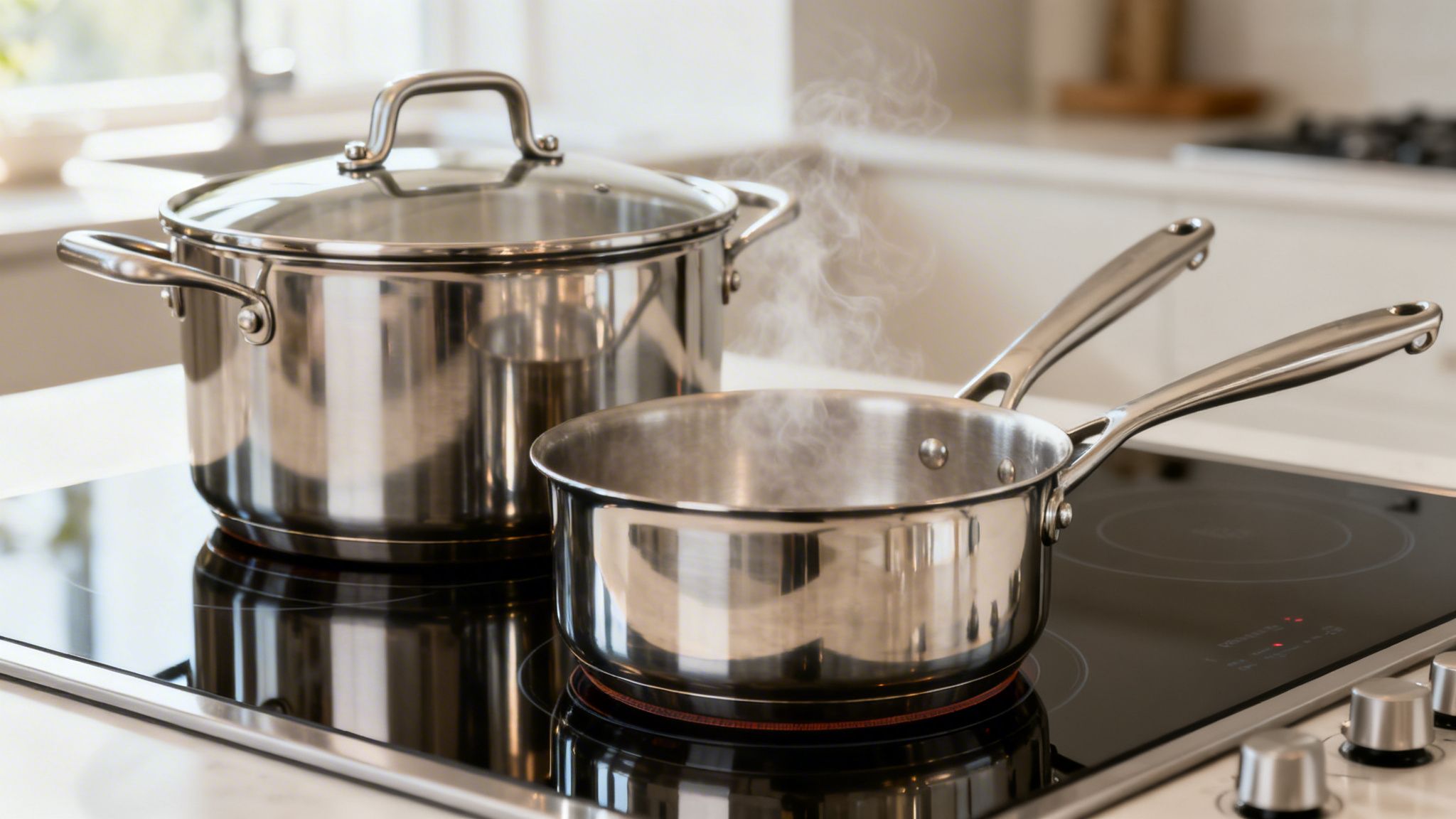
The real secret is hidden between the layers of steel. On its own, stainless steel is actually pretty bad at conducting heat. To fix this, manufacturers sandwich a highly conductive metal, usually aluminum or copper, between the steel. This layered construction is called cladding, and it's what gets rid of hot spots, ensuring your food cooks evenly from the center all the way to the rim.
Understanding Multi-Ply Construction
You'll constantly see terms like "3-ply" and "5-ply" thrown around. This isn't just marketing fluff; it tells you exactly how a pan is built and gives you a good idea of how it will perform on the stove.
3-Ply (Tri-Ply): This is the classic, tried-and-true setup. You get a core of aluminum or copper pressed between two layers of stainless steel. It’s the perfect middle ground, offering solid, even heating and quick responsiveness when you turn the flame up or down. It heats up fast and is usually lighter than its 5-ply cousins.
5-Ply: This is a more beefed-up construction. It adds extra layers, often alternating between stainless steel and aluminum, sometimes with a copper core for good measure. The result? Absolutely phenomenal heat distribution and retention. These pans take a little longer to heat up, but once they're hot, they hold that temperature with incredible stability, giving you ultimate control for finicky dishes.
Think about searing a thick steak. A 5-ply pan's amazing heat retention means the surface temperature won't drop when the cold meat hits the pan, giving you a much better crust. On the flip side, a 3-ply pan's quicker reaction time is perfect for sautéing vegetables, where you might need to adjust the heat on the fly. To get a better handle on the materials, our guide explains what makes stainless steel ideal for cookware.
Here’s a key insight for shoppers: more layers don't automatically mean better. A well-made 3-ply set from a top-tier brand will almost always outperform a cheaply made 5-ply set. Pay more attention to the build quality and core material than the layer count alone.
Practical Features That Elevate a Set
Beyond the number of layers, a few design details make a world of difference in your day-to-day cooking. These are the things that separate a good set from one you'll truly love using.
Oven and Stovetop Compatibility
Pretty much any top-rated stainless steel set will work on every type of stovetop, including induction, thanks to the magnetic steel used for the exterior. You'll also want to look for an oven-safe rating of at least 500°F (260°C). This is a game-changer. It means you can sear a chicken on the stove and pop the whole pan straight into the oven to finish, a technique essential for so many recipes.
Handle Design and Ergonomics
You’re going to be lifting these pans a lot, so comfort is a big deal. The best handles are securely riveted to the pan's body for a rock-solid, confident grip. Contoured, "stay-cool" handles are designed to dissipate heat and fit comfortably in your palm, saving you from nasty burns on the stovetop. Some cooks swear by classic straight handles, while others prefer rounded, ergonomic designs that feel more natural when lifting and pouring.
Lids and Rims
A small detail with a huge impact. Snug-fitting lids are non-negotiable for trapping heat and moisture when you're simmering a sauce or steaming vegetables. Some sets give you glass lids so you can see what's going on, while others stick with ultra-durable stainless steel lids. Also, keep an eye out for flared or tapered pouring rims. It’s a subtle feature, but it lets you pour out liquids without any annoying drips running down the side of the pan.
Getting to Know Modern Nonstick Cookware
If you're still picturing the flimsy, easily-scratched nonstick pans from decades ago, it's time for an update. Today’s top-rated nonstick cookware is a whole different ballgame. We're talking sophisticated kitchen tools engineered for convenience, low-fat cooking, and surprisingly good durability. They're the undisputed champion for anyone who wants to flip a perfect pancake, slide a delicate fish fillet onto a plate, or cook eggs without a hint of sticking.
The nonstick world is now run by two major players: hard-anodized aluminum with a PTFE coating, and ceramic nonstick. Both give you that effortless food release we all crave, but they get there in different ways and require their own specific kind of TLC. Nailing down these differences is the secret to picking a set that you'll love using for years.
The real magic of a great nonstick set isn't about blasting it with high heat for a hard sear; it's about the control and consistency it brings to your everyday meals.
Hard-Anodized vs. Ceramic Nonstick: What’s the Difference?
Once you start shopping, you'll see these two terms pop up constantly. They describe the pan's body and its cooking surface, and each one brings something different to the table.
Hard-Anodized Aluminum (PTFE): This is what you'll find in most high-performance nonstick pans, and for good reason. The hard-anodizing process creates a pan body that's incredibly tough, scratch-resistant, and non-porous—even tougher than stainless steel. A high-quality, multi-layer PFOA-free PTFE coating is then applied to this rugged base. The result? A slick surface that lasts a long time when you treat it right and usually offers fantastic heat distribution.
Ceramic Nonstick: Ceramic coatings are made from a sand derivative using a process called sol-gel, which results in a hard, glossy surface. A big selling point is that they're completely free of PTFE and PFOA. While ceramic pans deliver amazing nonstick performance right out of the box and can often take a bit more heat, their nonstick abilities tend to fade faster than a top-tier PTFE pan, especially if you overheat them or get aggressive with scrubbing.
Here's the most important takeaway: the lifespan of any nonstick pan, whether it's PTFE or ceramic, comes down to how you care for it. Using the right utensils and keeping the heat in check are absolutely non-negotiable.
What Does "PFOA-Free" Actually Mean?
You’ll see “PFOA-free” stamped on just about every nonstick pan today. Perfluorooctanoic acid (PFOA) was a chemical used way back when to make traditional nonstick coatings, but it raised some serious health concerns.
Since 2013, cookware brands have completely phased PFOA out of their manufacturing. This means any modern nonstick pan you buy from a reputable company is considered safe for home cooking. The golden rule is to always use them as intended—on low to medium heat—to ensure the coating never breaks down.
For a much deeper dive into the specific types and safety of modern nonstick surfaces, check out our complete guide to the top-rated nonstick cookware: https://www.cookwarereviewhub.com/top-rated-nonstick-cookware/. This guide will give you all the details you need to make a confident choice.
How to Make Your Nonstick Pans Last
A quality nonstick set is an investment, and you want it to pay off. A few simple habits can dramatically extend its life and keep that slick surface working like it’s brand new.
Essential Care and Maintenance Tips
- Low to Medium Heat is Your Friend: High heat is the ultimate enemy of nonstick coatings. It degrades the surface, destroying its ability to release food.
- Use Wood or Silicone Utensils: Never, ever use metal spatulas, whisks, or tongs. Even tiny scratches will compromise the coating over time and lead to peeling.
- Hand-Wash Whenever You Can: I know, many sets say "dishwasher-safe," but the harsh detergents and high heat in a dishwasher will wear down the coating much faster. A quick, gentle wash with a soft sponge and a little soap is always your best bet.
- Skip the Cooking Sprays: Those aerosol sprays build up a sticky, invisible residue that’s nearly impossible to remove and will ruin the pan's nonstick properties. A small drop of oil or a little butter is all you'll ever need.
Exploring Cast Iron and Enameled Sets
For cooks who are serious about heat retention and want something that could literally be passed down for generations, cast iron is in a league of its own. It’s a completely different beast compared to the quick-heating stainless steel or the easy-cleanup nonstick pans. Cast iron is all about soaking up heat and radiating it out steadily and evenly. This is what makes it the undisputed champ for everything from a deep, crusty sear on a steak to the perfect skillet cornbread.
The world of cast iron basically breaks down into two camps, and both have their die-hard fans.

On one side, you've got traditional, bare cast iron—the kind that asks for a little TLC to build up a naturally nonstick surface we call seasoning. On the other, there's enameled cast iron, which gives you that same awesome heat performance but comes coated in a low-maintenance, colorful finish. The choice isn't about which one is better overall, but which one makes more sense for the kind of food you love to cook.
Traditional Cast Iron: The Seasoning Process
A traditional cast iron skillet is more than just a pan; it’s a relationship that gets better with every meal. The "seasoning" process is just a fancy way of saying you're baking thin layers of oil onto the surface. This creates a tough, polymerized layer that's naturally slick. Most new skillets arrive pre-seasoned, but the real magic happens as you use it, building up that beautiful, dark patina over time.
This is the pan you reach for when you need to bring the heat. Its ability to hold a blistering temperature makes it untouchable for:
- Frying: Getting that perfectly crisp, golden-brown skin on fried chicken is where cast iron truly sings.
- Searing: It delivers a deep, flavorful Maillard reaction on steaks and burgers that other materials just can't match.
- Baking: From gooey skillet cookies to cornbread with crunchy edges, the pan’s even heat ensures a perfect bake from the outside in.
The classic skillet is a kitchen icon for a reason. In fact, if you look at the wider cookware market, the sheer versatility of pans and skillets is undeniable. They command a massive 27.0% market share—beating out pots and woks—and make up 40% of the pieces in complete sets sold globally, simply because everyone needs a great pan for frying and searing. You can dig into more of this data in a detailed market analysis from Grand View Research.
Enameled Cast Iron: Beauty Meets Performance
Enameled cast iron delivers all the heat-hugging benefits of its traditional cousin, but without the seasoning homework. A smooth, non-reactive layer of enamel—which is essentially powdered glass fused to the iron—seals the core material. This coating not only makes it a breeze to clean but also means you can cook acidic ingredients like tomatoes or wine without worrying about them reacting with the metal.
This "just works" appeal makes enameled pieces, especially the famous Dutch oven, a go-to for anything low and slow.
The real superpower of enameled cast iron is how it handles moist-heat cooking. The heavy, tight-fitting lids are brilliant at trapping steam, which creates the perfect humid environment for braising tough cuts of meat until they’re falling apart or simmering stews for hours on end.
Where Enameled Cast Iron Really Shines:
- Braising and Stewing: It’s tailor-made for slow-cooked classics like pot roast, coq au vin, or beef bourguignon.
- Soup Making: That heavy bottom is fantastic for preventing scorching when you’re simmering big batches of soup.
- Bread Baking: Many home bakers swear by their Dutch ovens for trapping steam to produce artisan-style bread with an incredible crust.
So, should you get a full cast iron set? It really comes down to how you cook. Most home chefs find that a hybrid approach works best. Bringing in one or two key pieces—like a 12-inch traditional skillet for searing and a 6-quart enameled Dutch oven for braises—gives you the best of both worlds, seriously upgrading your kitchen without a complete overhaul.
Finding Value at Amazon and Costco
Getting your hands on a top-rated cookware set doesn't mean you have to drain your bank account. Two of the biggest names in retail, Amazon and Costco, offer great deals, but they take very different approaches. The trick is figuring out which store's style matches how you like to shop—and whether you value endless options or expertly curated value.
Amazon’s biggest draw is its absolutely massive, unmatched selection. You can find sets from just about every brand imaginable, from starter-kitchen-friendly options to premium, professional-grade collections. This huge variety lets you do some serious comparison shopping right from your couch, helped along by thousands of user reviews that give you the real-world scoop on performance.
Of course, navigating this digital ocean of products takes a bit of work. The sheer volume can feel overwhelming, and it's on you to filter through the noise to find what you actually need.
Shopping Smart on Amazon
For the dedicated deal-hunter, Amazon is a playground. Prices are always changing, and you can score major savings on top-rated sets during lightning deals or big sales events like Prime Day. The user reviews and Q&A sections are pure gold, often giving you honest feedback on long-term durability you'll never find in a product description.
The main challenge is making sure both the product and the seller are legit.
- Filter by "Verified Purchase": This is a must. It ensures you're reading reviews from people who actually own the item.
- Look for “Sold by Amazon” or the Brand’s Official Storefront: Buying directly from Amazon or the brand itself is the best way to steer clear of fakes.
- Double-Check Return Policies: Amazon’s A-to-z Guarantee is fantastic, but third-party sellers can have their own set of rules.
Here's a pro tip for shopping on Amazon: don't just look at the overall star rating. Make a point to read the 3- and 4-star reviews. They often have the most balanced, nuanced feedback, pointing out minor flaws or specific issues that the glowing 5-star raves and angry 1-star rants tend to miss.
The Costco Approach to Cookware
Costco plays a completely different game: curation over endless choice. Instead of scrolling through hundreds of options, you'll find a small, carefully selected lineup from reputable brands, often sitting right next to their own highly-praised Kirkland Signature line. The sets are almost always bundled to offer incredible per-piece value.
The Kirkland Signature stainless steel set, for instance, has a legendary reputation for delivering performance that punches way above its weight class, rivaling brands that cost two or three times as much. Costco uses its immense buying power to get fantastic products at lower prices, and they pass those savings right on to their members.
Shopping for Cookware at Amazon vs. Costco
So, which retail giant is the right fit for you? It really boils down to what you value most in a shopping experience. This head-to-head comparison should help you decide where to start your search for the perfect cookware set.
| Feature | Amazon | Costco |
|---|---|---|
| Selection & Variety | Nearly limitless; includes niche brands and all major manufacturers. | Highly curated; a few select brands plus the exclusive Kirkland Signature line. |
| Pricing & Deals | Dynamic pricing with frequent sales, lightning deals, and coupon options. | Consistently low everyday prices on bundled sets, offering strong bulk value. |
| Customer Reviews | Massive volume of user reviews, Q&As, and customer photos. | Limited to no online reviews on their site; value is based on brand trust. |
| Return Policy | Generally strong and easy, but can vary with third-party sellers. | Legendary, no-questions-asked return policy on nearly everything they sell. |
At the end of the day, it comes down to personal preference. If you're the type who loves deep-diving into research, comparing dozens of options, and sniffing out the absolute best deal, Amazon’s endless digital aisle is for you. But if you’d rather trust that expert buyers have already done the hard work and just want a straightforward, high-value option with an unbeatable return policy, then a trip to Costco is probably your best bet.
Taking Care of Your New Cookware So It Lasts
Getting a top-rated cookware set is a great first step, but how you care for it is what really turns that purchase into a lifelong kitchen partner. Every material has its own quirks, and getting to know them is the secret to keeping your pans looking and performing like new. Skipping these simple maintenance steps is the fastest way to ruin your new gear.
Proper care really does make a difference, meal after meal. For example, that slick surface on a brand-new nonstick pan can be destroyed in a heartbeat by high heat or a metal spatula. And stainless steel can lose its beautiful shine if you don't use the right cleaning tricks.
Care Instructions for Each Material
Different surfaces need different game plans. A cleaning method that makes stainless steel sparkle could permanently wreck a nonstick coating. Here’s a quick rundown of what you need to know.
Stainless Steel Maintenance
To keep your stainless steel looking brilliant, always let the pan cool down a bit before you wash it. For those stubborn, stuck-on bits or weird discoloration, a paste made from baking soda and water is a game-changer. A specialized cleaner like Bar Keepers Friend works wonders, too. Just stay away from steel wool—it will scratch the surface up for good.
Nonstick Cookware Preservation
The golden rules for nonstick are pretty simple: low-to-medium heat only, always use silicone or wood utensils, and make sure to hand-wash it with a soft sponge. High heat and harsh dishwasher detergents are the number one killers of nonstick surfaces. Oh, and skip the aerosol cooking sprays; they leave behind a sticky buildup that's nearly impossible to scrub off.
The biggest myth about cast iron? That you can never, ever use soap. A tiny bit of mild dish soap is totally fine for a well-seasoned pan. The real key is to dry it completely and wipe on a super-thin layer of oil afterward to keep that seasoning strong.
Cast Iron Seasoning and Cleaning
With cast iron, it's all about the seasoning. After you cook, scrub the pan with a stiff brush and hot water. Then, pop it on the stovetop over low heat to dry it completely. While it's still warm, wipe a very thin layer of cooking oil over the entire surface. This process is what builds and maintains that amazing natural nonstick layer.
Smart Storage to Prevent Damage
How you store your cookware is just as important as how you clean it. Stacking pans directly on top of each other is a surefire way to get scratches, especially on nonstick and enameled finishes.
To avoid this, just slip a paper towel, a soft cloth, or a dedicated pan protector between each piece. If you’ve got the room for it, a hanging pot rack is an even better solution. It eliminates any contact and keeps your go-to pans right where you can grab them.
Common Questions About Cookware Sets
Diving into the world of cookware can feel a little overwhelming, especially with all the options out there. It's totally normal to have questions pop up when you're trying to find the perfect set for your kitchen. Getting those questions answered is the last step to making a smart buy you'll be happy with for years.
We've noticed that most shoppers get hung up on the same few things—from figuring out the best material for a new cook to wondering about the safety of modern nonstick pans. Let's tackle these common questions head-on with some straight-up, practical advice.
What Is the Most Versatile Type of Cookware Set for a Beginner?
For anyone just starting to stock their kitchen, a high-quality stainless steel set is, without a doubt, the most versatile workhorse you can buy. It's a true all-rounder that can handle just about anything you throw at it, from searing a steak on high heat to gently simmering a sauce. Plus, this stuff is incredibly durable, oven-safe, and plays nicely with every kind of stovetop, including induction.
Sure, there’s a bit of a learning curve to get the hang of heat control with stainless steel, but the skills you pick up are the foundation of good cooking. A great place to start is an 8-piece set. This usually gives you a skillet, two saucepans, and a stockpot with lids—basically, everything you need for day-to-day meals.
Are Ceramic Nonstick Cookware Sets Safer Than Traditional Nonstick?
This is a really common question, and an important one. The short answer is that today, both traditional (PTFE-based) and ceramic nonstick coatings are made without PFOA, which was the chemical that caused all the health concerns years ago. When you use them the way the manufacturer tells you to, both types are considered perfectly safe for home cooking.
The real key to safety and a long life for any nonstick pan is managing your heat. Blasting any nonstick coating with super high heat will cause it to break down. Stick to low and medium heat to protect your pan's surface and keep it performing safely for a long time.
How Many Pieces Do I Really Need in a Cookware Set?
The perfect number of pieces really just depends on how many people you're cooking for and how often you're in the kitchen. It's easy to get wowed by a massive 16-piece set on sale, but it pays to be honest with yourself about what you'll actually pull out of the cabinet.
For most home cooks, an 8 to 10-piece set is the sweet spot. A set this size almost always covers the essential, everyday workhorses:
- One or two skillets for frying, searing, and sautéing.
- A couple of different-sized saucepans for liquids, grains, and sauces.
- A big stockpot for soups, stews, and boiling pasta.
- Lids that fit all the corresponding pots and pans.
Choosing a set with just the right number of pieces means you have all the tools you need without cluttering up your kitchen with pans you never touch. It's a focused approach that lets you invest in quality pieces you'll reach for again and again.
At Cookware Review Hub, we're dedicated to helping you make smarter kitchen purchases with in-depth reviews and practical guides. Find your next favorite kitchen tool at https://www.cookwarereviewhub.com.


