When you're trying to choose between David Burke GeoClad and HexClad, it boils down to one key question: Are you looking for a great everyday pan or a high-performance workhorse? GeoClad is a budget-friendly ceramic nonstick pan built for daily tasks, while HexClad is a premium stainless-steel-nonstick hybrid engineered for serious searing and culinary enthusiasts. Your best bet depends on whether you value affordability for daily meals or you're ready to invest in top-tier durability and heat control.
Now loading...
Choosing Your Next Hybrid Pan
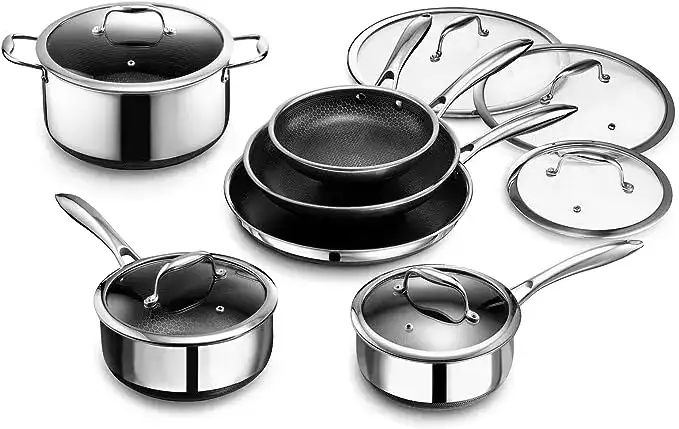 | HexClad 12 Piece Hybrid Stainless Steel Cookware Set - 6 Piece Frying Pan Set and 6 Piece Pot Set with Lids, Stay Cool Handles, Dishwasher Safe, Induction Ready, Metal Utensil Safe Now loading... |

Navigating the world of modern cookware can feel a bit overwhelming, with every brand promising the best of both nonstick ease and stainless-steel power. David Burke GeoClad and HexClad are two of the biggest names in this hybrid space, but they get there using completely different technology and, frankly, at wildly different prices. Getting a handle on these differences is the first step toward finding a pan that actually fits the way you cook.
At-a-Glance Comparison GeoClad vs HexClad
To kick things off, here’s a quick summary of the most important differences. This should give you an immediate feel for where each pan stands before we dive into the nitty-gritty.
| Feature | David Burke GeoClad | HexClad |
|---|---|---|
| Core Technology | Laser-etched geometric ceramic nonstick surface | Patented stainless steel hexagonal grid over a nonstick surface |
| Primary Material | Tri-ply stainless steel with a full ceramic coating | Tri-ply stainless steel with a hybrid nonstick system |
| Best For | Everyday nonstick cooking, eggs, fish, pancakes | High-heat searing, achieving a crust, versatile cooking |
| Price Point | Budget-friendly (typically under $50) | Premium (often over $100 per pan) |
| Metal Utensil Safe | Not recommended to preserve the ceramic coating | Yes, the steel grid protects the nonstick valleys |
| Dishwasher Safe | Yes, but handwashing is recommended for longevity | Yes |
As you can see, these pans are built for two very different kinds of cooks. Let's break down what that means in the kitchen.
Core Philosophies in Cookware
The David Burke GeoClad pan uses a patented laser-etched geometric pattern on its ceramic nonstick surface. The whole idea is to deliver solid nonstick performance that holds up over time, all built on a tri-ply stainless steel body that heats evenly up to 500°F. With a typical price under $40, it's an accessible way for the casual cook to get a taste of hybrid technology without breaking the bank.
HexClad, on the other hand, is playing a completely different game. Its famous technology combines stainless steel "peaks" with nonstick "valleys," giving you the searing power of steel with the easy release of nonstick. It's a more complex and expensive design, but it pays off in durability and versatility. To see if this premium pan really lives up to the hype, check out our in-depth HexClad cookware review.
When you compare these two, you're not just looking at features—you're deciding on a cooking philosophy. Do you need a reliable, affordable tool for daily tasks, or a high-performance instrument for culinary exploration?
Of course, a single pan is just one part of a well-equipped kitchen. If you're thinking bigger, exploring an Ultimate Commercial Kitchen Equipment Checklist can offer a broader perspective on outfitting your cooking space. In the sections ahead, we’ll break down exactly how these pans perform head-to-head in construction, cooking tests, and overall value.
Comparing Construction and Design

When you get right down to it, the real differences between David Burke GeoClad and HexClad start at their core. The way they’re built and the materials they use define everything—from how well they control heat to the way they feel in your hand. This is where you’ll find the first clues to which pan is right for your stovetop.
At its heart, the David Burke GeoClad pan is built on a classic tri-ply foundation. You've got a layer of aluminum tucked between two layers of stainless steel, a time-tested construction famous for its even, responsive heating. It’s a huge leap from your standard aluminum pan. You can dive deeper into how these layers work in our ultimate guide to 5-ply stainless steel cookware.
But the real twist with GeoClad is its cooking surface. They’ve laser-etched a unique geometric pattern and then coated the entire thing with a ceramic nonstick layer. The idea here is to give you the best of ceramic—easy food release and a PFOA-free surface—while the texture creates tiny air pockets to help food slide right off.
HexClad’s Patented Hybrid Approach
HexClad also starts with a tri-ply body, but their surface is a completely different animal. Their signature is the patented laser-etched hexagonal grid that creates a network of stainless steel "peaks" and nonstick "valleys." This hybrid design is engineered to give you the sear of stainless steel with the cleanup of nonstick.
This is the construction that really put hybrid cookware on the map. HexClad promised the searing power of steel, the ease of nonstick, and the heat retention of cast iron, all in one pan. Their design, which hit the market around 2016, is undeniably robust. It’s worth noting, however, that while the pan comes with a lifetime warranty, this usually doesn’t cover the natural breakdown of the nonstick coating over time. Most experts agree that nonstick surfaces last somewhere between 3 and 10 years, depending on how you treat them.
The core difference is crystal clear: GeoClad fully coats its textured surface with ceramic nonstick, putting easy food release first. HexClad leaves its steel grid exposed to prioritize searing power and the freedom to use metal utensils.
Ergonomics and Handling In The Kitchen
 | HexClad 7 Quart Hybrid Saute Pan, Nonstick Chicken Fryer, Dishwasher and Oven Friendly, Compatible with All Cooktops |
Beyond the cooking surface, the actual feel of the pan—its ergonomics—plays a massive part in whether you’ll love using it day in and day out.
- David Burke GeoClad: This pan feels lighter, more nimble in the hand. The handle is straightforward and comfortable, great for everyday jobs like flipping omelets or sautéing veggies. It’s well-balanced for anyone who prefers cookware that isn’t a workout to lift.
- HexClad: The first thing you notice about HexClad is its heft. It's a heavier, more substantial pan, which is fantastic for heat retention but can feel a bit cumbersome to some. The handle is equally robust and designed to stay cool, but the pan’s overall weight gives it a more anchored, solid feel on the cooktop.
This difference in weight directly translates to how you'll cook. The lighter GeoClad is a breeze to maneuver for quick meals. In contrast, the heavier HexClad provides a rock-solid base for getting a deep, even sear on a thick-cut steak without the pan budging an inch. The right choice really comes down to your personal cooking style and what feels good in your hand.
Real-World Cooking Performance

While specs and materials tell you part of the story, the real truth comes out on the stovetop. It's time to move past the marketing and see how the David Burke GeoClad and HexClad pans actually handle real food in everyday cooking situations. This is where the subtle design differences turn into very noticeable results.
We ran both pans through three core kitchen tasks designed to push them to their limits: getting a hard sear on a steak, gently cooking delicate foods, and building a flavorful fond for a pan sauce. The results were clear—these are two very different pans built for two very different cooks.
High-Heat Searing A Steak
For a hybrid pan, nothing matters more than its ability to lay down a deep, even crust on a good piece of meat. We took a thick-cut New York strip, got both pans ripping hot over medium-high heat with a little oil, and got to work.
The HexClad pan showed its cards almost immediately. That stainless steel grid made direct contact with the steak, erupting in a satisfying sizzle and quickly forming a fantastic, dark brown crust. Its heavier construction held onto heat like a champ, so the pan's temperature didn't crash when the cold steak hit it. That’s key for a consistent sear.
On the other hand, the David Burke GeoClad just wasn't built for this job. Its full ceramic nonstick coating, while great for other things, struggled to deliver the same maillard reaction. The pan heated up fast and evenly, sure, but a surface designed to prevent sticking is inherently going to inhibit the deep browning that makes a steak great. The steak cooked through just fine, but the crust was lighter and patchy.
When it comes to searing, it's not even a competition. The exposed steel on the HexClad gives it a massive advantage, delivering the kind of crust you'd expect from a classic stainless steel or cast iron pan. The GeoClad acts like a premium nonstick pan here, which is the wrong tool for this particular task.
Delicate Foods The Egg and Fish Test
Next up, we tested the nonstick performance that's so critical for daily cooking. We fried a couple of eggs with just a whisper of oil and then seared a delicate, skin-on salmon fillet to see which pan offered the cleanest release.
This is where the David Burke GeoClad absolutely came alive. Its silky-smooth ceramic surface was flawless. The eggs glided around the pan like they were on ice, sliding onto the plate with zero fuss. The salmon skin crisped up beautifully and released without a hint of sticking, leaving the fish perfectly intact.
The HexClad did a good job, but it has a bit of a learning curve. Because of those steel peaks, some food—especially eggs—can get stuck if you don't nail the preheating or use enough oil. Our egg test went fine, but it demanded more attention to temperature than the GeoClad. The salmon released cleanly, but the GeoClad simply provided a more forgiving, foolproof experience.
Performance on Delicate Foods
| Task | David Burke GeoClad | HexClad |
|---|---|---|
| Fried Eggs | Excellent. Effortless release with minimal oil. Food just slides right off. | Good. Needs proper preheating and a bit more oil to keep eggs from catching on the steel grid. |
| Pan-Seared Salmon | Excellent. Crispy skin, zero sticking. Perfect for protecting delicate fish. | Very Good. Releases cleanly, but the steel can be less forgiving than a fully nonstick surface. |
This test really puts a spotlight on the GeoClad's biggest strength: it's a superior nonstick pan for fragile foods.
Creating Pan Sauces Building a Fond
 | HexClad Cookware 14 Inch Wok and Lid with Stay Cool Handles, Hybrid Stainless Steel PFOA-Free Non-Stick Surface |
One of the best things about cooking with stainless steel is the fond—those delicious browned bits that get stuck to the bottom of the pan after searing. That fond is pure flavor, and it's the foundation of any great pan sauce.
After searing some chicken thighs, the HexClad left behind a beautiful layer of browned bits. When we hit the pan with some chicken stock to deglaze, the fond lifted right off the surface, creating an amazing base for a sauce. This is the hybrid design paying off, letting you sear and create a sauce in the same pan, just like a pro.
The David Burke GeoClad’s nonstick surface, by its very nature, prevented much fond from forming at all. The chicken cooked well, but the pan was left almost perfectly clean. No browned bits means no pan sauce. It's a classic trade-off you make with any fully nonstick pan.
For any cook who loves finishing a dish with a homemade pan sauce, the HexClad is the clear winner. It successfully blends the searing power of steel with just enough nonstick property to make life easy. The GeoClad, while a champ at other tasks, simply isn't designed for this style of cooking.
Durability and Upkeep: What to Expect Long-Term
A great pan isn't just about how it cooks on day one; it's about how it holds up to a busy kitchen year after year. When we put David Burke GeoClad against HexClad, their durability and cleaning routines tell you a lot about what it’s like to actually live with these pans. How they handle scratches, daily cleaning, and warranty issues can honestly be the dealbreaker for many of us.
The way each pan is built is the first clue to its resilience. HexClad's entire marketing pitch hinges on its hybrid design—that stainless steel grid protecting the nonstick valleys. They proudly claim it's metal utensil safe. In my experience, this means you can grab a metal spatula without instantly gouging the surface. Over time, you might see some fine scratches on the steel peaks, but it's mostly cosmetic and doesn't really affect performance.
David Burke's GeoClad, with its solid ceramic surface, is a different beast entirely. It's tough for a ceramic pan, but it is not recommended for use with metal utensils. If you do, you will scratch and wear down that nonstick layer, and its lifespan will plummet. You absolutely have to stick with wood or silicone tools to keep the surface in good shape.
Day-to-Day Cleaning and Maintenance
Nobody wants to spend more time cleaning than cooking, so ease of care is a huge deal. Both brands say they're dishwasher safe, but let's be real—the reality is a bit more complicated.
The David Burke GeoClad, with its smooth ceramic, is a breeze to clean by hand. Most food gunk just glides off with a soft sponge and a little soapy water. While you can toss it in the dishwasher, the harsh detergents and high heat are the fastest way to kill any nonstick coating, ceramic included. To get the most life out of it, handwashing is the only way to go.
HexClad is also marketed as dishwasher safe, and its beefy construction does hold up better to the ordeal. But even with HexClad, handwashing is still the best practice for preserving those nonstick properties. Sometimes, burnt-on bits can get stuck in that stainless steel lattice, requiring a little more elbow grease than a perfectly smooth pan. For those really tough messes, knowing how to properly clean HexClad pans is a game-changer for keeping them in top form.
Key Takeaway: Both pans are happier when you handwash them. GeoClad practically demands it to protect its delicate ceramic, while HexClad will simply last longer if you take the extra minute to wash it in the sink.
The Warranty and Real-World Lifespan
A warranty often shows how much a brand backs its own product, and this is where you see a major difference in philosophy. David Burke GeoClad usually offers a standard, limited warranty that covers manufacturing defects. This is pretty typical for pans in this price bracket and won't cover normal wear and tear or the inevitable decline of the nonstick surface.
HexClad, on the other hand, makes a big splash with its lifetime warranty, which is a huge part of justifying that premium price tag. This covers defects in the pan's construction for its entire life. But—and this is a big but—it's crucial to read the fine print. The guarantee does not cover the nonstick coating itself, which is expected to wear down after a few years of regular use. Most experts in the industry agree that a good nonstick surface has a functional life of three to ten years, depending on use and care.
So, what does this actually mean for you?
- GeoClad's Warranty: It protects you from getting a dud right out of the box, but the long-term care and performance are all on you.
- HexClad's Warranty: You get peace of mind knowing the pan's body won't fall apart, but you still need to care for the nonstick surface just like any other pan.
At the end of the day, HexClad's tougher build and better warranty suggest it's built for a longer haul, especially if you're the kind of cook who can't live without metal utensils. GeoClad is an excellent value but requires a gentler touch to keep its nonstick magic alive over the years.
Breaking Down the Price and Value
Let’s get right to it: the most glaring difference between a David Burke GeoClad and a HexClad pan isn’t how they cook—it’s how much they cost. Honestly, for most people, this is the final deciding factor. The price gap is huge, and it completely changes how you think about the value of each pan.
A single 10-inch David Burke GeoClad pan usually runs somewhere between $30 to $40. It’s an easy, budget-friendly pickup. Now, compare that to a 10-inch HexClad, which will set you back $130 or more. That’s a fourfold jump in price. It forces you to ask a pretty important question: is HexClad really four times better, or is GeoClad the smarter buy for a fraction of the cost?
The Value Proposition of GeoClad
For the everyday home cook, GeoClad is an absolute steal. You get the key perks of a hybrid pan—decent heat distribution from its tri-ply build and a nonstick surface you can count on—all at a price that doesn't make you wince. If you're mostly cooking eggs, pancakes, fish, or anything else that needs a forgiving nonstick surface, GeoClad gets the job done without a big investment.
Its real value is just how accessible it is. You could grab several GeoClad pans for your kitchen for what one HexClad pan costs. This makes it a perfect fit for:
- Students or anyone moving into their first apartment and needing to build a kitchen from the ground up.
- Budget-conscious families looking for reliable pans that can handle daily use.
- Home cooks who just want great nonstick performance and aren't too fussed about getting a deep, crusty sear.
Justifying the HexClad Premium
So why the hefty price tag for HexClad? It comes down to better versatility, serious durability, and a much stronger warranty. The ability to lay down a steakhouse-quality sear, use your metal spatula without panicking, and build up a proper fond for a pan sauce puts it in a whole different category. For someone who is passionate about cooking, this isn't just a pan; it's a long-term piece of kitchen gear.
The cookware market, with brands like David Burke GeoClad and HexClad, is a great reflection of what's happening in the broader economy. This huge price difference between a $30 GeoClad and a $150+ HexClad shows there are two totally different types of buyers: those looking for immediate value and those willing to invest in premium performance and brand trust. You can find more insights about the cookware market and how it’s changing.
The decision really just boils down to how you cook. GeoClad offers fantastic value for its price as a dedicated nonstick pan. HexClad provides a higher overall value for the serious cook who needs one pan that can go from searing a steak to sautéing vegetables without missing a beat.
Ultimately, "better value" is completely up to you. If you just need an affordable, excellent nonstick pan for daily breakfasts and dinners, GeoClad is the smarter choice, hands down. But if you’re a culinary enthusiast who will actually use the high-heat searing capabilities and appreciate the freedom to use metal utensils, then the upfront cost of HexClad feels less like a splurge and more like a worthwhile investment that will pay off for years.
The Final Verdict: Who Should Buy GeoClad and Who Should Buy HexClad?
After putting these pans through their paces, from construction analysis to real-world cooking tests, the showdown between David Burke GeoClad and HexClad isn't about crowning a single "winner." Instead, it's about matching the right tool to the right cook. These pans are built for two very different home chefs, and the best choice for you boils down to an honest look at your cooking habits, what you value on the stovetop, and your budget.
This isn't a simple "better or worse" scenario. It’s a classic trade-off: do you want everyday nonstick convenience or high-performance searing power? No single pan is the undisputed master of both, and these two sit at opposite ends of that hybrid spectrum. One is all about flawless food release, while the other is engineered to create that perfect, crusty sear.
The Ideal GeoClad User: The Everyday Cook
The David Burke GeoClad is the slam-dunk choice for the practical home cook who just wants exceptional nonstick performance for daily meals. Its fully coated ceramic surface is a dream for delicate foods that love to stick—think fried eggs, pancakes, or a piece of flaky fish. You can cook with confidence, knowing nothing will cling to the pan.
You should buy GeoClad if you:
- Mostly cook meals that need reliable, easy food release.
- Put a high value on a quick, effortless cleanup routine.
- Are a student, setting up a first apartment, or are a budget-conscious family.
- Don't mind using non-metal utensils to protect the ceramic coating.
The Ideal HexClad User: The Culinary Enthusiast
On the other hand, the HexClad pan is a better investment for the serious cook who craves versatility and isn't afraid of high heat. Its patented hybrid design gives you the searing muscle of stainless steel, letting you achieve a deep, even crust on steaks, chops, and burgers that GeoClad just can't touch. This is the pan for someone who loves building a fond and making pan sauces from scratch.
You should invest in HexClad if you:
- Frequently sear proteins and getting a perfect crust is your top priority.
- Want the freedom to grab a metal spatula or whisk without a second thought.
- Enjoy techniques like deglazing to create rich pan sauces.
- See your cookware as a long-term investment and are willing to pay a premium for durability and performance.
This simple decision tree helps visualize the core choice here, based on what you do most in the kitchen.

The takeaway is pretty clear: if your world revolves around daily nonstick cooking, GeoClad delivers unbeatable value. If you're chasing that professional-level sear, HexClad is the investment that will pay off. In the end, let your cooking style guide your decision.
Got Questions? We've Got Answers
When you're weighing two pans like David Burke GeoClad and HexClad, a few key questions always pop up. Let's tackle the practical, day-to-day stuff that will help you land on the right choice for your kitchen.
Can I Use Metal Utensils on These Pans?
 | HexClad Steak Knife Set, 4-Pieces Damascus Stainless Steel Blades, Full Tang Construction, Pakkawood Handles |
This is a huge fork in the road for many cooks. With HexClad, the answer is yes—it's specifically built to handle metal utensils. The raised stainless steel grid acts like a tiny shield, protecting the nonstick coating down in the valleys. You can grab a metal spatula without a second thought.
On the other hand, you should never, ever use metal on David Burke GeoClad. Its surface is a solid sheet of ceramic nonstick, and metal tools will absolutely scratch and ruin its slick performance over time. You'll need to stick with silicone or wood to keep it in good shape.
It really boils down to this: if you're the kind of cook who hates fussing over tools and just grabs whatever's closest, HexClad is your pan. But if you're already used to using softer utensils, GeoClad will do just fine.
Is the HexClad Price Tag Really Worth It?
That price gap isn't small, but whether it's "worth it" comes down to how you cook. HexClad’s premium cost is for its patented hybrid design, its incredible searing power, and a much tougher build quality that's backed by a lifetime warranty on the pan's structure. Think of it as an investment piece for serious home cooks who want one pan that can do it all, especially high-heat searing.
GeoClad, in contrast, offers fantastic value as a dedicated nonstick pan. It’s perfect for everyday jobs. If your priority is flipping the perfect omelet rather than getting a steakhouse crust, then paying the premium for HexClad's features is probably overkill.
Which Pan Cleans Up Easier?
Both pans are pretty low-maintenance, but GeoClad takes a slight lead here for everyday gunk. Its completely smooth ceramic surface lets food slide right off with barely any effort. A quick wipe is usually all it takes.
HexClad is also a breeze to clean most of the time, but its signature textured surface can occasionally trap little bits of food in the steel hexagons. It might take an extra pass with a sponge to get it perfectly clean. While both brands say their pans are dishwasher safe, we strongly recommend handwashing both to get the most life out of their nonstick coatings.
At Cookware Review Hub, we know the right pan can completely change your cooking game. For more deep dives and honest advice, check out our other guides and find the perfect tools to build your ideal kitchen.


