
Let's cut right to the chase. If you want the best possible wood for your cutting board, you can stop looking and just choose Hard Maple, American Black Walnut, or Cherry. These three hit the sweet spot—they're tough enough to shrug off deep scratches but have just enough give to keep your knives sharp. It’s why they’re the undisputed champions of durability, safety, and longevity.
Now loading...
Your Definitive Guide to Cutting Board Woods
Choosing a cutting board wood isn't just about what looks good on your counter; it’s an investment in a kitchen tool you'll rely on for years. The right material can actually extend the life of your knives, help prevent bacteria from setting up shop, and serve as a beautiful centerpiece for both prep and presentation. Getting a handle on the key characteristics of different woods is the first step to picking the perfect board. For a deeper look into what makes a great wood, check out this guide on choosing the right hardwood for longevity and style.
Now loading...
To make your decision a little easier, we’ve put together a quick comparison chart that lines up our top picks against some other popular options. Think of it as a quick visual reference to see the pros and cons at a glance.
Top Cutting Board Wood Comparison Chart
A quick comparison of the key characteristics of popular woods used for cutting boards, helping you see the pros and cons at a glance.
| Wood Type | Janka Hardness (lbf) | Knife Friendliness | Porosity | Maintenance Level |
|---|---|---|---|---|
| Hard Maple | 1,450 | Excellent | Low (Closed-Grain) | Moderate |
| Black Walnut | 1,010 | Superior | Low (Closed-Grain) | Moderate |
| Cherry | 950 | Superior | Low (Closed-Grain) | Moderate |
| Teak | 1,070 | Fair to Good | Low (Closed-Grain) | Low |
| Acacia | 1,700 | Fair | Low to Medium | Low to Moderate |
| Bamboo | 1,400 | Poor | Low (Non-Porous) | Moderate |
| Red Oak | 1,290 | Good | High (Open-Grain) | High |
This chart really drives home why our top three picks consistently come out on top. Their ideal hardness ratings, paired with a non-porous, closed-grain structure, make them the clear winners for a food prep surface.
They do ask for a bit of care—regular oiling and conditioning—but in return, you get a sanitary and durable board that's kind to your blades. On the flip side, woods like Teak and Acacia have high silica content that can dull knives surprisingly fast. And you’ll want to steer clear of open-pored woods like Red Oak entirely, as they’re notorious for trapping moisture and bacteria.
Now that you have the essentials upfront, let's explore the science behind what makes a truly great cutting board.
What Separates a Great Cutting Board from a Good One
Ever wonder why one wooden cutting board becomes a treasured kitchen heirloom, while another cracks and warps within a year? It's not just luck; it’s all about the wood itself. Picking the right wood is crucial, and it comes down to a few key properties that dictate how a board will perform, how safe it is, and ultimately, how long it will last in your kitchen.
Think of it like choosing tires for a race car. You need the perfect balance of grip and durability. A board that's too hard is like driving on slick, unforgiving tires—it offers no give and wears down your equipment (your knives!). On the other hand, a board that’s too soft is like driving on underinflated tires; it gets damaged easily and just doesn't perform well. The magic is all in finding that "just right" balance.
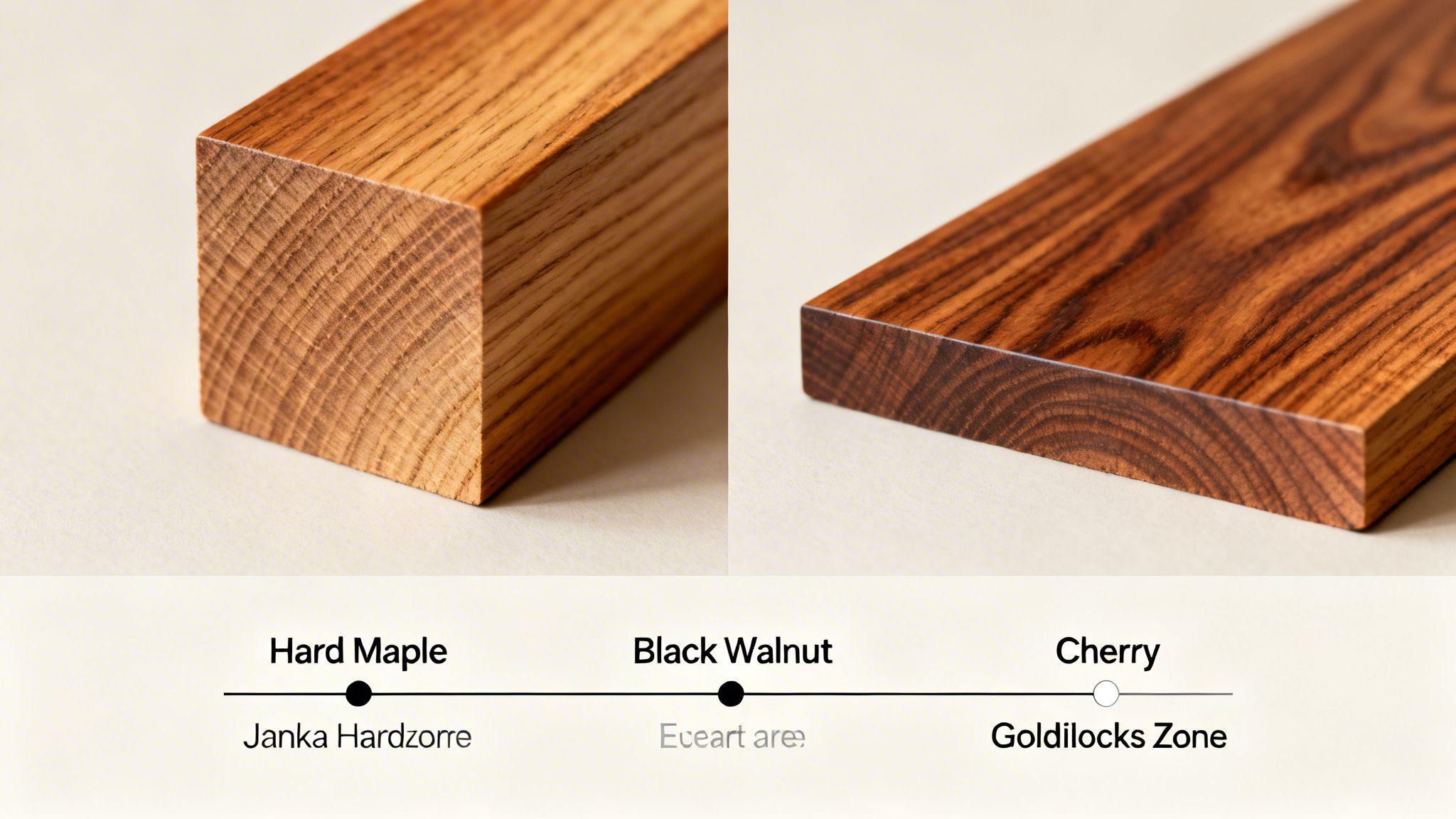
The Hardness Goldilocks Zone
The most critical factor is a wood's hardness, which we measure using the Janka Hardness Scale. This scale tells us how much force it takes to sink a small steel ball halfway into a piece of wood. A higher number means harder wood. Pretty simple.
Ever since its development in the early 1900s, the Janka scale has been the industry standard. For cutting boards, there's a definite sweet spot: somewhere between 950 and 1,750 lbf (pounds-force). This range is the perfect compromise, offering enough durability to shrug off deep gouges while staying soft enough to protect the fine edge of your expensive chef's knife. You can learn more about how wood hardness impacts board performance and find the best woods for your culinary needs.
So what happens if you stray from this zone?
- Too Hard (above 1,750 Janka): Woods like Ipe or even some species of Acacia can feel like you're chopping on a slab of granite. They will absolutely destroy your knife edges, forcing you to sharpen them constantly.
- Too Soft (below 950 Janka): On the flip side, softer woods like Pine or Fir will scar deeply with every single cut. These grooves don’t just look bad; they become tiny hiding places for bacteria that are a nightmare to clean out.
Grain Structure: The Unseen Hero of Food Safety
Hardness is only half the story. The wood's grain structure plays a massive, often overlooked, role in whether it belongs in your kitchen. You see, wood is made of countless tiny pores—like microscopic straws—that once carried water through the tree. The size of these pores is what makes a wood "closed-grain" or "open-grain."
A closed-grain wood has tiny, dense pores. Think of it like a tightly woven fabric that naturally repels water. This structure is exactly what you want, as it prevents moisture, food bits, and bacteria from seeping deep into the board. This is why the best cutting board woods—Maple, Walnut, and Cherry—are all closed-grain hardwoods.
An open-grain wood, like Red Oak, is the opposite. It has large, visible pores. Imagine a sponge; those big openings are perfect traps for moisture and germs, creating a food safety issue that's almost impossible to fully sanitize.
A great cutting board doesn't just provide a surface to cut on; it actively contributes to a cleaner, safer kitchen. Its closed-grain structure acts as a natural barrier, preventing bacteria from finding a place to hide.
End Grain vs. Edge Grain Construction
The final piece of the puzzle is how the board is actually put together. You'll mainly see two styles: end grain and edge grain. Each has its own strengths.
- Edge Grain (or Face Grain): This is the most common style you'll find. Long strips of wood are laid on their sides and glued together, with the long, beautiful grain facing up. It makes for a durable, stable, and more affordable board.
- End Grain: This construction is a bit more complex. The wood is cut into blocks and glued together so the "ends" of the wood fibers face up. Picture looking down at the cut end of a bundle of straws.
While edge grain boards are fantastic all-rounders, end grain boards have a unique trick up their sleeve often called "self-healing." When your knife cuts into an end grain surface, the blade slips between the vertical wood fibers. After the knife lifts, the fibers close back up. This action is incredibly gentle on your knife's edge and helps the board's surface stay smoother for much longer. The trade-off? This intricate construction makes end grain boards more expensive and more absorbent, meaning they need more frequent oiling and care.
Meet the Champions of the Kitchen
Alright, we’ve talked about the science behind a great cutting board. Now, let's get to the fun part: meeting the superstars of the kitchen. These are the woods that consistently prove their worth, striking that perfect balance of durability, kindness to your knives, and food safety. We'll walk through the "big three" so you can find the perfect match for your cooking style.
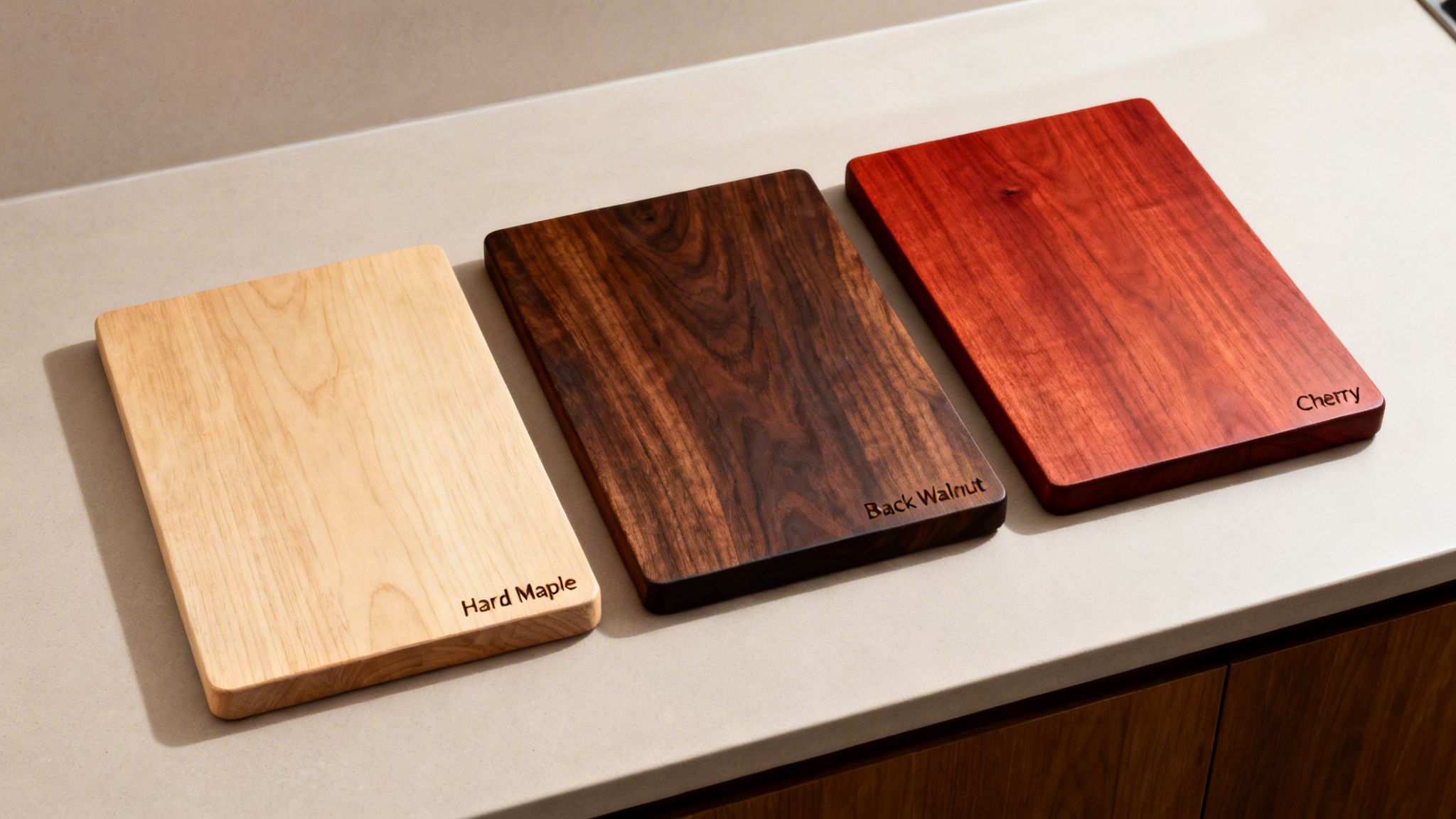
Hard Maple: The Unquestionable Standard
When you imagine a classic, heavy-duty butcher block, you're almost certainly picturing Hard Maple. For good reason, it’s been the gold standard for decades. Its dense, closed-grain structure creates an incredibly tough surface that naturally keeps bacteria and moisture at bay.
Hard Maple is the undisputed king of the cutting board world, making up roughly 40-50% of all premium board sales in North America. Its Janka hardness rating of 1,450 lbf hits the sweet spot—it’s tough enough to handle years of abuse but has just enough give to not destroy your knife edges. This is why it's the go-to for professional chefs and serious home cooks alike. You can learn more about how wood properties contribute to the best cutting board performance on Blade and Burnish.
Its creamy, neutral color is another plus. It gives you a clean, high-contrast surface for chopping colorful veggies and doesn't stain as easily as softer woods. It's a true workhorse.
- Pros:
- Extremely Durable: That 1,450 Janka rating means it can take a beating from daily chopping and heavy cleaver work.
- Hygienic Surface: Its tight, small pores are a fortress against bacteria and moisture trying to sneak in.
- Knife-Friendly: It’s tough, but not too tough. It won't dull your prized chef's knife prematurely.
- Cons:
- Requires Regular Oiling: Like any quality hardwood, it gets thirsty. You need to keep it oiled to prevent it from drying out and cracking.
- Can Stain: While it's resistant, things like beet juice or turmeric will leave their mark if you don't clean up quickly.
Ideal For: The serious home cook, the meal-prepper, or anyone who needs a reliable, bomb-proof work surface that will last for years.
American Black Walnut: The Luxurious Choice
If Hard Maple is the trusty pickup truck, then American Black Walnut is the sleek luxury sedan. It adds instant sophistication to any kitchen with its deep, chocolatey tones and gorgeous, swirling grain patterns. It’s the kind of board you’ll want to show off as a serving platter for cheese and charcuterie.
But it isn't just a pretty face. With a Janka rating of 1,010 lbf, Black Walnut is noticeably softer than maple. This gentler nature is a huge bonus for anyone with high-end, razor-sharp knives, as it helps preserve that delicate edge for much longer. It's a favorite among chefs who've invested serious money in their cutlery.
Of course, that softness is a double-edged sword. While it pampers your knives, the board itself will show scratches and knife marks more easily. It's a trade-off many cooks are happy to make for the board's stunning looks and blade-saving properties.
- Pros:
- Exceptional Knife Care: Its softer surface is incredibly gentle on expensive, high-carbon steel knives.
- Stunning Aesthetics: That rich, dark color is a showstopper and makes food pop.
- Naturally Antimicrobial: Just like other closed-grain hardwoods, it's a safe and hygienic choice.
- Cons:
- Shows Scratches: Being softer means it will develop a "patina" of use more quickly. Some love the look, others don't.
- Higher Price Point: Walnut is a premium wood prized for fine furniture, so it often comes with a higher price tag.
Cherry: The All-Around Performer
Sitting right in the sweet spot between Maple and Walnut, you'll find Cherry. It offers a fantastic middle ground. With a Janka rating of 950 lbf, it’s soft enough to be kind to your knives but still plenty durable for everyday kitchen duties.
What really makes Cherry special is its color. It starts out as a light, almost pinkish-brown and, with a bit of time and sunlight, deepens into a rich, warm reddish-brown. This beautiful aging process means your cutting board develops its own unique character and gets more beautiful with every passing year. For many, that evolving beauty is its biggest draw.
While it is a closed-grain hardwood, it's a touch more porous than maple, so staying on top of your oiling routine is crucial. Still, its solid performance and gorgeous looks make it a wonderful and dependable choice for just about any kitchen. If you're particularly interested in top-tier woods like maple, consider diving deeper with our comprehensive guide on selecting the best maple cutting board.
- Pros:
- Beautiful Aging Process: The wood darkens and develops a rich, warm patina over time. It's a board with a story.
- Good Balance: It’s a great compromise between knife-friendliness and durability.
- Sustainable Sourcing: American Cherry is a common and sustainably harvested wood, making it a responsible choice.
- Cons:
- Needs Consistent Care: It can be a little more sensitive to moisture if you let it get too dry.
- Can Dent Easily: Its lower hardness means a dropped can or heavy pan could leave a dent.
Good Contenders and Woods to Avoid
Once you get past the “big three” of Maple, Walnut, and Cherry, the world of cutting board woods opens up. You’ll find a lot of other popular options out there, each with its own quirks. Some are fantastic but need a little extra TLC, while others look beautiful on the shelf but can be a real headache in the kitchen.
Figuring out these differences is the key to picking a board you'll love for years, instead of one you regret buying. Let's take an honest look at these other contenders—the good, the bad, and the ones you should run from.
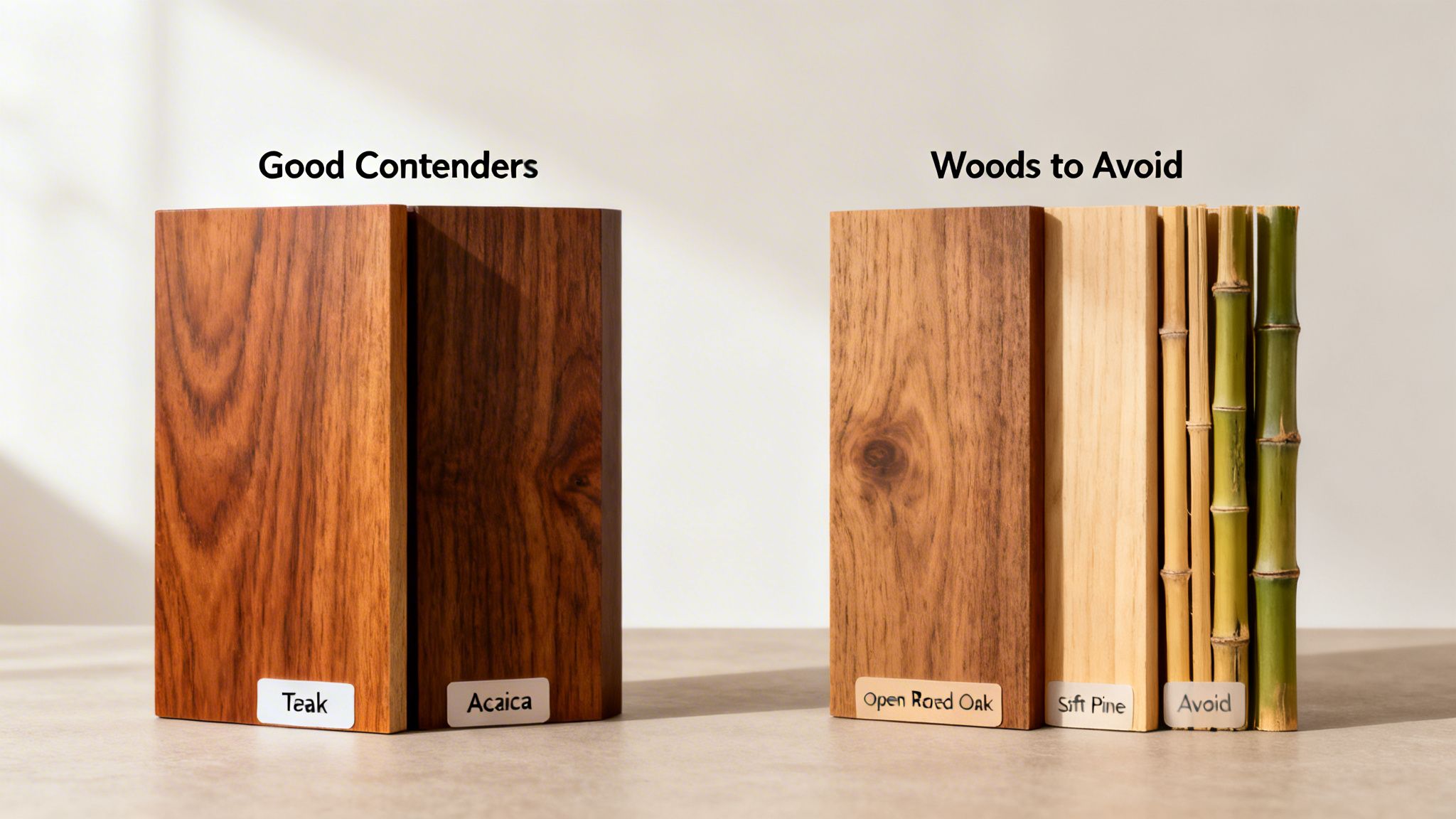
Popular Woods with Trade-Offs
Some woods have shot up in popularity because they’re tough and look incredible. They can definitely be solid choices, but they come with a few strings attached that you need to know about before you pull the trigger.
Teak: Famous for its stunning golden-brown color and serious durability, Teak is what they build boat decks with for a reason. It's naturally packed with oils that make it incredibly water-resistant. The catch? It’s also packed with silica—basically, microscopic bits of sand.
While the oils make it a breeze to maintain, that high silica content is notoriously hard on a good knife. A Teak board will dull your chef's knife much faster than Maple. It's a classic trade-off: you get a gorgeous, low-maintenance board, but get ready to sharpen your knives more often.
Acacia: You’ve probably seen Acacia everywhere. It's a trendy choice, loved for its wild, beautiful grain patterns and sustainable reputation. It's also a very hard wood, often clocking in at over 1,700 on the Janka scale, which means it resists scratches like a champ.
But just like Teak, that hardness can be a double-edged sword. Acacia often has a high silica content, too. That mineral grit, combined with its natural density, creates a surface that’s pretty unforgiving on your blades. It’s a durable and often budget-friendly option, but it won’t coddle your knives like the top-tier woods.
The Great Bamboo Debate
Bamboo is marketed as the ultimate eco-friendly, cheap, and durable alternative to wood. And while it's true that bamboo is a fast-growing grass, it's a pretty terrible material for a cutting surface.
The main issue is its sheer hardness. Bamboo fibers are incredibly dense, and when they're glued together to make a board, the resulting surface is often harder than rock maple. Chopping on bamboo feels clacky and harsh, and it will absolutely wreck a sharp knife edge in short order.
On top of that, a bamboo board isn't a solid piece of material. It’s made of countless tiny strips of grass fused together with a whole lot of glue. Every time your knife comes down, it's hitting those glue lines, which is another great way to dull your blade.
Bamboo might be a sustainable resource, but its extreme hardness and glue-heavy construction make it one of the worst choices for anyone who cares about keeping their kitchen knives sharp.
Woods You Should Absolutely Avoid
Alright, now for the hard no's. Some woods are just fundamentally wrong for a cutting board. Using them isn't just a bad idea for your knives—it can be a genuine risk to your health.
- Open-Pored Woods (like Red Oak and Ash): These woods have large, visible pores that act like tiny straws. They’ll suck up meat juices, bacteria, and moisture, making them nearly impossible to clean and sanitize. Always stick to closed-grain woods for a hygienic kitchen.
- Softwoods (like Pine, Fir, and Cedar): Any wood from a cone-bearing tree is a softwood. They are way too delicate for a cutting surface and will get gouged and scarred after just one use. Those deep cuts become perfect breeding grounds for bacteria, making the board unsafe and unusable.
Choosing a cutting board is about more than just looks; it's a decision that affects your expensive tools and your food's safety. While some people think glass boards are an easy-to-clean alternative, they come with their own major problems. You can see how they stack up in our guide on glass vs. wood cutting boards to understand why wood usually wins.
Protecting Your Investment with Proper Care
A high-quality wood cutting board is more than just a tool; it's an investment in a kitchen partner that can genuinely last a lifetime—if you treat it right. Proper care is surprisingly simple and doesn't require some complicated routine, but it is the single most important factor in preventing your board from warping, cracking, or becoming a food safety headache.
I like to think of the wood like skin. If you don't keep it moisturized, it gets dry, brittle, and prone to damage. The same exact principle applies to your cutting board. A little bit of regular care keeps those wood fibers hydrated, resilient, and ready for whatever you throw at them, preserving both its function and its good looks for years to come.
Your Essential Cleaning Routine
The foundation of good board care starts the moment you're done chopping. The number one, most important rule is to never, ever put a wooden cutting board in the dishwasher. The intense heat and prolonged soak will cause it to warp and split, sometimes after just one wash.
Instead, just follow this simple process every time:
- Wash by Hand: Grab a soft sponge with a little mild dish soap and hot water to gently scrub both sides of the board. It's crucial to wash both sides evenly to prevent one side from drying faster than the other—that's a classic recipe for warping.
- Rinse Thoroughly: Run the board under hot water until all the soap residue is gone.
- Dry Immediately: Use a clean towel to pat the board completely dry. Don't skimp on this step!
- Air Dry Upright: Stand the board on its edge so air can circulate around all surfaces. This ensures it dries completely and evenly.
The Oiling and Conditioning Ritual
Cleaning keeps your board sanitary, but oiling is what keeps it healthy. Oiling is simply the process of soaking the wood fibers with a food-safe oil to help them repel water and stop them from drying out. This quick monthly ritual is the real secret to a board that lasts for decades.
For this job, you only want to use food-grade mineral oil. You'll want to avoid cooking oils like olive or vegetable oil. They'll eventually go rancid and make your board smell funky.
To take that protection up a notch, I recommend using a board conditioner, which is usually a mix of mineral oil and natural waxes like beeswax. The oil soaks deep into the wood, while the wax creates a protective barrier right on the surface, doing an even better job of repelling moisture. For some more in-depth advice on wood care that applies just as well to boards, this guide on caring for butcher block countertops is a great resource.
Tackling Common Problems
Even with the best care, you might run into a few issues. Here’s how to handle them.
- Removing Tough Stains and Odors: For those stubborn berry stains or the lingering smell of garlic, sprinkle the board generously with coarse salt. Cut a lemon in half and use it to scrub the salt into the surface. The salt acts as a gentle abrasive, and the lemon's citric acid helps lift stains and kill odors. Let it sit for about five minutes, then scrape it all off and give the board a good rinse.
- Fixing Minor Splits: If you notice a tiny crack forming, it’s a sure sign the board is thirsty. Clean it, let it dry completely, and then apply several heavy coats of mineral oil over a couple of days. This will help rehydrate the wood and can often close up those small splits.
By sticking to this simple maintenance plan, you’ll ensure your board remains a safe, beautiful, and reliable centerpiece in your kitchen. This kind of care is also a huge part of creating a truly nontoxic cutting board environment.
Choosing the Perfect Cutting Board for Your Needs
Alright, you've got a handle on the woods and how to care for them. Now comes the fun part: picking a board that fits your kitchen like a glove. This isn't about finding some mythical "best" board that works for everyone. It's about finding the right board for how you actually cook.
Think of it like choosing a partner for your culinary adventures. The best board for you will complement your habits, whether you’re a busy parent cranking out weeknight dinners, a serious foodie geeking out over complex recipes, or someone who loves to put on a good spread for friends. Let's break down the best options for different styles of cooks.
For The Everyday Home Cook
If you need a reliable workhorse for daily meal prep, your priorities should be durability and practicality. You want a board that can take a beating—from dicing onions day after day to carving a roast chicken on Sunday—without needing constant coddling.
- Best Wood: Hard Maple is your undisputed champ. Its dense, non-porous surface is tough, hygienic, and forgiving when it comes to maintenance.
- Best Construction: An edge-grain board is the way to go. It offers fantastic stability and a super long lifespan at a price point that makes sense for a daily driver.
- Recommended Size: Aim for something around 12×18 inches. This gives you plenty of room to work but isn't a beast to wash in the sink or tuck away.
For The Serious Food Enthusiast
For those of you who've invested in high-end knives and treat cooking as a craft, protecting your blade's edge is just as critical as the board's own durability. You're after performance and that satisfying feel of quality tools in your hands.
- Best Wood: American Black Walnut or Cherry are your best friends here. They're a bit softer, which makes them exceptionally gentle on a fine, razor-sharp edge, keeping it that way for longer.
- Best Construction: Go for an end-grain board. This is the ultimate upgrade. Its "self-healing" fibrous surface feels amazing to cut on and is the kindest surface you can give your prized cutlery.
- Recommended Size: Go big or go home. An 18×24-inch board (or larger!) gives you a generous workspace to manage multiple ingredients without everything feeling cramped.
And when your board starts to look a little tired, this visual guide can help you diagnose and treat its most common issues in a snap.

As the decision tree shows, whether your board is dry, stained, or a little funky, a simple kitchen remedy is usually all you need.
For The Host Who Loves Presentation
If your cutting board pulls double duty as a serving platter for cheese, charcuterie, or appetizers, then looks matter. A lot. You're looking for a functional piece of art—a true showstopper for your countertop and table.
- Best Wood: Walnut brings dramatic, deep tones that make food pop, while Acacia offers stunning, high-contrast grain patterns. Both serve as a gorgeous backdrop for any spread.
- Best Construction: A handsome edge-grain board, perhaps one with a live edge or a unique shape, strikes the perfect balance between beauty and serving practicality.
- Key Tip: Seriously consider getting two boards. Have one workhorse for all the messy prep work, and keep a dedicated "presentation" board pristine for guests. This is also just good food safety practice to avoid cross-contamination between raw meats and ready-to-eat foods.
A Few More Things About Wood Cutting Boards
Even after you've picked the perfect board, a few questions always seem to pop up. Let's clear the air on these common debates so you can feel completely confident about your new kitchen centerpiece.
Is End-Grain Really That Much Better Than Edge-Grain?
This is the big one, the classic debate. The truth is, it completely depends on what you value in the kitchen.
For the serious home chef or anyone who's invested in high-end Japanese knives, an end-grain board is absolutely superior. Think of it like a dense brush—the knife's edge slips between the vertical wood fibers, which then close back up. This self-healing magic is incredibly gentle on your blade, keeping it sharper for much, much longer.
But for most of us, a high-quality edge-grain board is the more practical choice. It's easier on the wallet, tough as nails for daily chopping, and doesn't need to be oiled quite as obsessively. A solid edge-grain maple or walnut board is a fantastic workhorse that will serve you well for years.
How Often Should I Oil My New Cutting Board?
A brand-new board is like a thirsty sponge. For the first month, you'll want to be generous and oil it once a week. This initial "seasoning" is vital. You're building up its natural resistance to water and preventing it from cracking as it settles into your home's environment.
After that first month, you can ease up. Just give it a good oiling once a month or anytime it starts to look a little pale or dry.
A quick but crucial tip: Never, ever use cooking oils like olive or vegetable oil. They'll go rancid over time, leaving you with a sticky, stinky mess. Always stick with food-grade mineral oil.
Can I Actually Prepare Raw Meat on a Wood Board?
Yes, you absolutely can! This is probably the biggest myth out there, but good science has shown that wood is a perfectly safe surface for raw meat. The secret is in the wood itself.
Dense, closed-grain woods like maple are naturally antimicrobial. Studies have found that the wood fibers actually pull bacteria down below the surface, where they get trapped and die off as the board dries. Of course, this doesn't mean you can skip basic food safety.
- Clean It Right Away: As soon as you're done, wash your board with hot, soapy water.
- Keep a Separate Board: To be 100% safe and prevent any cross-contamination, many chefs just keep one board dedicated to raw proteins. It's a simple habit that offers total peace of mind.
At Cookware Review Hub, we're all about helping you find the kitchen tools that make cooking a joy. For more expert guides and reviews, come explore with us at https://www.cookwarereviewhub.com.