
Finding the best French press isn't about crowning a single winner. It’s about matching the right brewer to your daily coffee ritual, focusing on things like material, filter quality, and overall design.
Now loading...
If you’re after a fantastic balance of durability and performance, the Frieling Stainless Steel is a premium workhorse. For those just starting out, the classic Bodum Chambord offers incredible value and a timeless look.
Now loading...
How to Choose the Best French Press for Your Kitchen
The search for the perfect French press can feel like a rabbit hole, but it really just boils down to a few key factors. This brewing method is loved for one simple reason: it makes a rich, full-bodied cup of coffee. By steeping coarse grounds directly in hot water, you’re getting what’s called a full immersion brew.
This direct contact is what makes French press coffee so special. It pulls out all the flavorful oils and aromatic compounds that paper filters usually trap. The result is a uniquely textured and robust brew that you can really feel on your palate.
The modern coffee lover’s move toward manual brewing has put the French press back in the spotlight. It offers an elegant, screen-free morning ritual and a much more eco-friendly alternative to single-use pod machines. This isn't just a niche trend, either; the global French press market was valued at a whopping US$904.6 million in 2024 and is set to grow even more. You can read more about the rising popularity of specialty coffee brewing at home.
Key Factors to Consider
Before you hit "buy," let's zero in on the three elements that truly define a quality French press:
- Durable Materials: Are you a fan of the classic look? Glass lets you watch the magic happen. Need something unbreakable that keeps your coffee hot? Stainless steel is your best friend. Or maybe you want something stylish that holds a steady temperature? Ceramic is a great choice.
- Fine-Mesh Filter: A well-made, multi-layer filter is the secret to a clean cup. It’s what stands between you and a mouthful of sediment. A good filter system is non-negotiable for a smooth brew.
- The Right Size: French presses come in all shapes and sizes, from a personal 12 oz brewer to a large 51 oz carafe that’s perfect for brunch with friends.
The goal is to find a brewer that slots right into your life. Do you need a rugged press for travel, or an elegant one for your countertop? Do you drink one cup or brew for the whole family? Answering these questions will point you straight to the perfect choice.
To make your decision even easier, we've put together a simple comparison table of our top picks. This guide helps you quickly spot the ideal model, whether you're a beginner on a budget or a coffee aficionado ready to upgrade.
Our Top French Press Picks for 2026
Here's a quick-glance comparison of our favorite French presses, handpicked for different needs and budgets.
| Model | Best For | Key Feature | Price Range |
|---|---|---|---|
| Bodum Chambord | Beginners & Value | Timeless design and reliable performance | $$ |
| Frieling Stainless Steel | Durability & Heat Retention | Double-wall insulation keeps coffee hot | $$$$ |
| ESPRO P7 | Silt-Free Coffee | Patented double micro-filter system | $$$$ |
| Coffee Gator | Gifting & Travel | Includes a bonus travel canister | $$$ |
Whether you're looking for an affordable classic like the Chambord or a high-tech, silt-free experience with the ESPRO P7, this table should help steer you in the right direction. Each of these models delivers a fantastic cup of coffee, just in slightly different ways.
The Magic of Immersion Brewing
Ever wonder what gives French press coffee that uniquely rich, velvety texture? The secret is a beautifully simple process called immersion brewing, where coffee grounds are fully submerged in hot water for the entire brew time.
Think of it like steeping a perfect pot of loose-leaf tea. Instead of water just passing through the grounds, they get to mingle and dance together in the carafe. This long, direct contact allows for a deep, full extraction of flavorful oils and delicate aromatic compounds—the very things that paper filters often trap and discard. The result is a coffee with a satisfyingly heavy body, robust flavor, and a silky mouthfeel that coats your tongue.
The Anatomy of a Perfect Brew
The real magic of a French press is how its simple parts work together. It’s a beautiful dance between time, temperature, and mechanics.
- The Carafe: This is the main stage where the coffee and water hang out. Whether it’s made of glass, steel, or ceramic, its job is to keep the temperature steady throughout the brew.
- The Plunger and Filter: This is the heart of the operation. The fine mesh filter is designed to separate the coarse grounds from your finished coffee, but it’s just porous enough to let all those precious oils and tiny coffee particles (micro-fines) through. That’s where the body comes from.
This combination is what creates the signature French press character. Unlike a pour-over where water is just passing through, immersion is a patient soak.
This gentle steeping is what pulls out that full-bodied, complex flavor profile that coffee lovers rave about. It's less about speed and more about letting the coffee fully express itself, creating a brew that is both rich and deeply aromatic.
From Grounds to Golden Cup in Four Minutes
The classic French press routine is a straightforward four-minute journey. It starts with "blooming" the coffee—a small pour of hot water that lets trapped CO2 gas escape from fresh grounds. Don't skip this 30-second step; it’s crucial for getting an even extraction and avoiding sour notes.
After the bloom, you add the rest of the water and let the grounds steep. This is where the water works its magic, dissolving all those delicious flavors and oils. Finally, a slow, steady press of the plunger separates the liquid gold from the spent grounds, leaving you with a perfect cup. Each step plays a part in hitting that perfect balance of strength and smoothness.
This simple infographic breaks down the core decisions you'll make when picking out a press:

As you can see, the material you choose affects how well your press holds heat, while the filter design changes the clarity and texture of your coffee. It all comes down to what you're looking for in your morning cup.
Comparing Materials: Glass vs. Stainless Steel vs. Ceramic

The material of your French press does more than just catch your eye; it’s a big deal for durability, how well it holds heat, and what it’s like to use every day. Picking the right material is a huge step in finding the best French press for your morning ritual. Let's walk through the three main options to see which one fits you best.
The Classic Glass Carafe
When most of us picture a French press, we're thinking of a classic glass carafe. It has a timeless look, and there's something special about watching the beautiful, swirling dance of coffee grounds and water as your brew steeps. It’s a full sensory experience that really adds to the ritual of making coffee.
Most good glass presses are made from borosilicate glass. This isn't your standard-issue glass; it’s engineered to handle wild temperature swings without cracking. That resistance to thermal shock is non-negotiable when you're pouring near-boiling water into it.
But the elegance of glass does come with a couple of strings attached.
Pros:
- Visual Experience: You get to watch your coffee brew, which is not only cool but also helps you see what's happening.
- Pure Flavor: Glass is non-porous. It won't hang onto old flavors or smells, guaranteeing a clean-tasting cup every single time.
- Affordable: Glass models, like the iconic Bodum Chambord, are often easier on the wallet than their steel or ceramic cousins.
Cons:
- It's Glass: Even tough borosilicate glass can break if you drop it or bang it against the sink.
- Loses Heat Fast: Glass isn't a great insulator. It loses heat more quickly than other materials, which can lead to a weaker, under-extracted brew if you’re not on top of it. Pre-heating the carafe is a must.
The Durable Stainless Steel Press
If durability and keeping your coffee hot are your top priorities, a stainless steel French press is the clear winner. These things are the workhorses of the coffee world, built to handle drops, dings, and the general chaos of a busy morning. Many are even tough enough for camping or travel.
The best stainless steel models have double-wall vacuum insulation. It works just like a high-end travel mug, creating a barrier that dramatically slows down heat loss. Your coffee will stay piping hot from the first cup to the last, perfect for those who like to sip slowly or serve a crowd.
For coffee lovers, top-rated picks like the Frieling Stainless Steel French Press are a favorite. Its double-wall design keeps coffee hot 30% longer than glass models. And people are definitely catching on; French press sales in the US shot up 18% during the 2020 pandemic as home brewing took off. Amazon alone reported shipping over 500,000 units in Q4 for popular brands like Bodum and Secura. You can dig into more of the numbers behind the rise of French press sales.
Stainless steel is the go-to for anyone who values longevity. It's virtually indestructible and offers superior thermal stability, ensuring your water temperature remains consistent throughout the crucial four-minute brew cycle.
The Stylish Ceramic Press
Ceramic French presses offer a beautiful mix of style and function. They bring an artisanal, handcrafted vibe to your kitchen counter and come in a whole spectrum of colors and glazes. You can easily find one to match your decor or act as a bold statement piece.
But it’s not just about looks. Ceramic offers excellent heat retention—way better than glass and on par with some double-walled steel models. The thick, heavy walls absorb and hold onto heat, creating a stable brewing environment that encourages a full, even extraction. For more on how materials stack up in the kitchen, check out our guide comparing ceramic vs stainless steel cookware.
The main downsides are weight and fragility. While it’s tougher than glass, ceramic can still chip or crack if you're not careful, and its heft makes it less ideal for travel compared to other options.
Ultimately, the best material for your French press comes down to what you care about most. Do you love the classic look and visual process of glass, the rugged durability of stainless steel, or the chic style and steady temperature of ceramic? Thinking through these pros and cons will point you straight to the perfect new addition for your coffee routine.
Mastering Your Grind, Ratio, and Brewing Technique
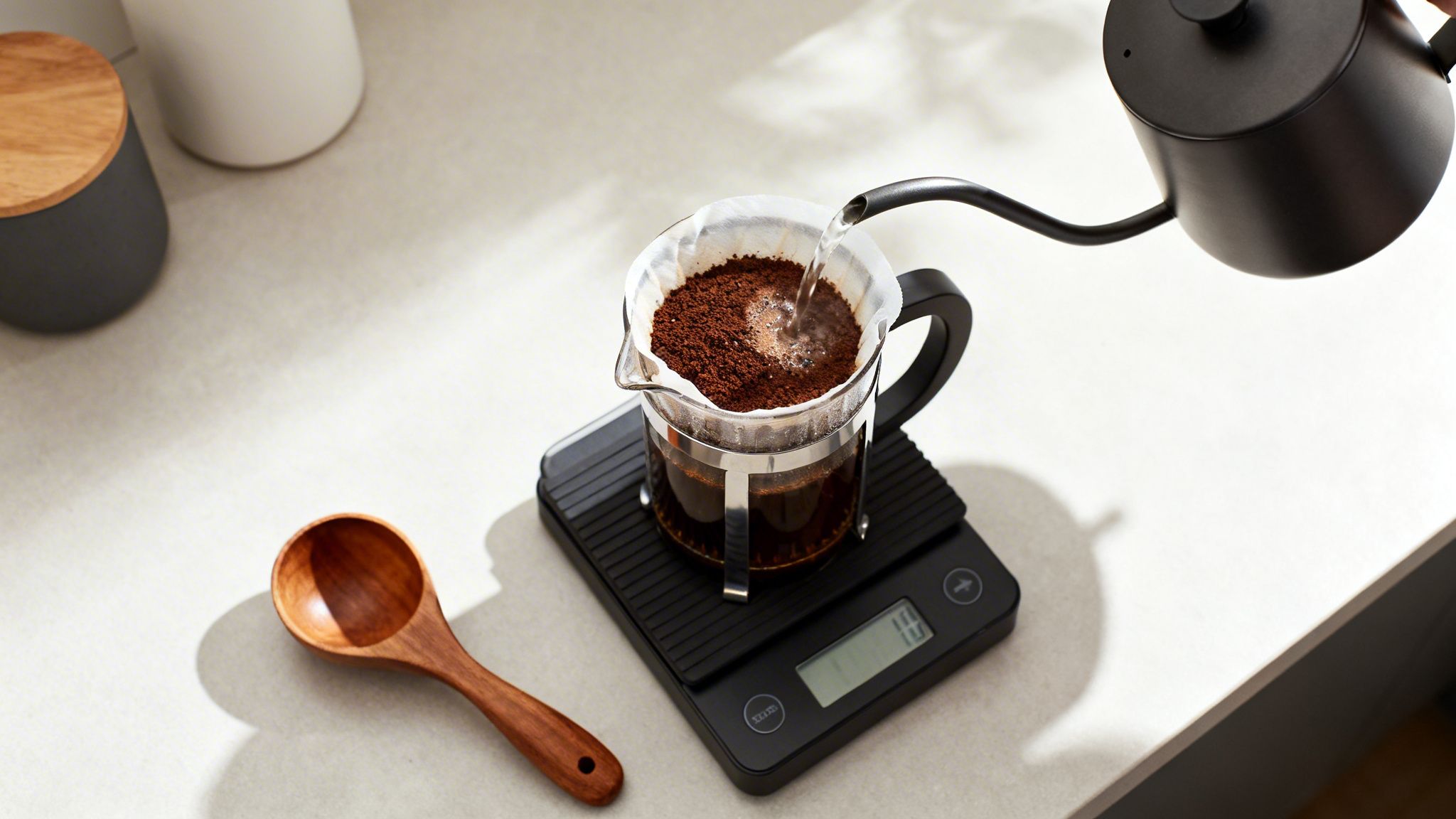
Having a great French press is only half the battle. The real magic happens when you get a handle on the details—the stuff that turns a decent cup of coffee into an amazing one. This is where you go from just making coffee to truly crafting it.
It all starts with two key things: your coffee-to-water ratio and the size of your coffee grounds.
Think of your coffee-to-water ratio as the recipe's blueprint. The "golden ratio" for French press is a fantastic starting point, generally somewhere between 1:12 and 1:15. In plain English, that's one gram of coffee for every 12 to 15 grams (or milliliters) of water.
A 1:12 ratio will give you a punchier, more robust brew. Lean toward a 1:15 ratio, and you'll get a milder, more delicate cup. Feel free to play around in this range—your taste buds are the final judge. A simple digital kitchen scale will be your best friend here, taking all the guesswork out of the equation for consistently great results.
Why Grind Size Is Everything
If there's one thing that will make or break your French press coffee, it's the grind size. For this kind of immersion brewing, you absolutely need a coarse, even grind. We're talking about a texture that looks like coarse sea salt or chunky breadcrumbs.
This isn't just a casual suggestion. The coarse grind creates the perfect amount of surface area for that four-minute steep, letting the water pull out all the rich, delicious flavors and oils without grabbing the nasty, bitter compounds. Go too fine, and the water will over-extract the grounds, leaving you with a bitter, sludgy mess. It can even clog the filter, making the plunger a nightmare to push down and forcing sediment right into your cup.
The secret weapon of every great home barista is a consistent grind. A cheap blade grinder just smashes beans into a chaotic mix of dust and boulders. This is a recipe for disaster, creating a cup that’s somehow both sour (from the under-extracted big pieces) and bitter (from the over-extracted fine dust). A quality burr grinder, on the other hand, mills the beans into uniform particles, which is the key to a balanced, clean, and flavorful brew.
If you're looking to dive deeper into grinders, our guide on choosing the best coffee grinder for cold brew has some great insights that apply here, too.
A Simple Recipe For The Perfect Cup
Ready to put it all together? This straightforward recipe will get you a fantastic cup every single time. We'll use a 1:15 ratio for a standard 34 oz (1-liter) press.
What You'll Need:
- A 34 oz French press
- 60 grams of whole bean coffee, ground coarse
- 900 grams (900 ml) of hot water, just off a boil (195-205°F or 90-96°C)
- A timer and a scale
Brewing Steps:
- Add Grounds: Tip your 60g of coarse coffee grounds into the empty French press carafe.
- Start the Bloom: Start your timer and pour in just enough hot water to saturate the grounds—about 150g should do it. Give it 30 seconds. You'll see the coffee bed puff up and bubble, which is called the "bloom." That's just CO2 gas escaping, and it's a great sign of fresh coffee!
- Add Remaining Water: After 30 seconds, gently pour in the rest of the water, another 750g. Pop the lid and plunger assembly on top, but don't press it down yet.
- Steep: Now, let it steep. Wait until your timer hits the 4-minute mark. If you like your coffee a bit stronger, you can push this to 5 minutes.
- Plunge Slowly: When the time is up, press the plunger down. Go slow and steady. A nice, gentle plunge of about 20-30 seconds will keep the coffee bed from getting stirred up, which helps keep fine particles out of your final cup.
- Serve Immediately: Don't let the coffee sit in the press! Pour it all out into your mugs right away. This stops the extraction and prevents the coffee from turning bitter.
How Grind Size Impacts Your French Press Coffee
Even with a solid recipe, sometimes things just don't taste right. More often than not, the grind is the culprit. Here’s a quick guide to help you troubleshoot.
| Grind Size | Resulting Flavor Profile | Common Issue |
|---|---|---|
| Too Coarse | Sour, weak, acidic, and thin-bodied. | Under-extraction: The water flows through too quickly without grabbing enough flavor. |
| Just Right | Sweet, balanced, with a rich body and pleasant aroma. | Perfect Extraction: You've hit the sweet spot for flavor and texture. |
| Too Fine | Bitter, harsh, and chalky with a muddy texture. | Over-extraction: Too much surface area leads to pulling out unpleasant compounds. |
Once you dial in these elements, your French press stops being just a coffee maker and becomes a tool for crafting a daily ritual you can truly look forward to. For more tips on honing your skills, check out excellent resources like this guide on How to Brew Peak Performance Coffee.
Our 2026 Review of the Top French Press Models
Alright, now that you've got a handle on the materials and the science behind a great brew, it's time for the fun part: picking the right French press. This is where we get to share our top picks, breaking down exactly what makes each one a winner in our book. We’ve put these brewers through their paces to see how they hold up in the real world, looking at everything from durability to the final taste in the cup.
Our list has something for everyone, whether you're just starting out on a tight budget or you're a seasoned coffee lover on a mission to banish silt from your morning ritual. We'll be looking at titans of the industry like Bodum, Frieling, and ESPRO, so you'll get a crystal-clear idea of which press is calling your name.
Best Overall Bodum Chambord
There’s a good reason the Bodum Chambord is what most people picture when they hear "French press." It's the quintessential model. Its timeless look, with that durable borosilicate glass carafe and classic chrome-plated frame, is a welcome sight on any kitchen counter. But more importantly, it just works. It delivers a consistently rich, full-bodied cup of coffee without any fuss.
Its three-part stainless steel mesh filter does a solid job of keeping the grounds where they belong, all while letting those flavorful coffee oils pass right into your mug. It’s a breeze to take apart for cleaning and incredibly simple to use, which makes it the perfect gateway for anyone new to the world of manual coffee brewing.
The Chambord's popularity isn't just a fluke. For shoppers at places like Amazon or Costco, it’s a dominant force, with over 100,000 units sold annually in the US, often for under $40. This tracks with a larger trend: as global coffee consumption rises, so does the demand for simple, eco-friendly brewers like the French press.
Best Value GSI Outdoors JavaPress
If you're brewing for a crowd or just need a burly workhorse that won't shatter on you, the GSI Outdoors JavaPress is a stellar pick. With its generous 33 oz (1 liter) capacity, it's perfect for a full family breakfast or serving guests at brunch.
The double-wall insulated design is a game-changer, keeping your coffee hot for much longer than a glass model. Plus, its shatter-resistant, BPA-free carafe makes it tough enough for camping trips or the daily chaos of a busy kitchen. This is a practical, no-nonsense brewer that puts function and durability first. If you need a lot of great coffee without a lot of hassle, you can't beat the value here.
Most Durable Frieling Stainless Steel
Is "buy it for life" your personal motto? Then meet your new best friend: the Frieling Stainless Steel French Press. Made from heavy-duty 18/10 stainless steel, this thing is practically indestructible. Its double-wall vacuum insulation is truly top-notch, promising to keep your coffee hot up to four times longer than a standard glass press.
Frieling also includes a dual-screen filter system that results in a cleaner cup with noticeably less sediment than many of its competitors. Sure, it’s an investment, but for the serious coffee enthusiast, its superior heat retention, unmatched toughness, and sleek design make it a worthy one. If you're curious about how it stacks up against others, check out our article on the top French press coffee makers from previous years.
This model isn't just about toughness; it's about performance. The stable brewing temperature provided by its insulated walls leads to a more balanced and complete extraction, elevating your final cup.
Best for Silt-Free Coffee ESPRO P7
Are you sick and tired of that gritty last sip? The ESPRO P7 was engineered from the ground up to solve the number one complaint about French press coffee: sediment. Its patented double micro-filter is 9 to 12 times finer than what you’d find in a typical press, which creates an incredibly clean, silt-free cup that gives a pour-over a run for its money in terms of clarity.
That dual-filter system also creates a vacuum seal the moment you plunge, completely stopping the extraction process. No more bitter coffee if you get distracted and let it sit too long. And remember, your press is more versatile than you think! The strong, concentrated coffee you get from a top-tier press like the ESPRO is the perfect base for other drinks, like a delicious Cafe au Lait using the traditional French press method.
Don't Let a Dirty Press Ruin Your Coffee
A clean French press isn't just a suggestion—it's the secret to consistently amazing coffee. Over time, coffee oils and fine grounds get trapped, go rancid, and will absolutely destroy the flavor of your next brew. Keeping your press spotless ensures every cup is as fresh and vibrant as you expect it to be.
Think of it like cooking with a dirty skillet. It doesn't matter how incredible your ingredients are; the end result will be tainted by old, burnt flavors. The same logic applies here. A quick rinse simply won't cut through the stubborn, oily film that coffee leaves behind.
The Daily Cleaning Ritual
Your best defense against buildup is a simple daily cleaning habit. This takes less than a minute but makes a world of difference in how your coffee tastes.
- Get Rid of the Grounds (The Right Way): Unless you enjoy calling a plumber, never wash coffee grounds down your sink. Instead, add a little water to the carafe, swirl it around to loosen the grounds, and dump them straight into your compost or trash. A small spatula is great for scraping out any that stick around.
- Rinse and Disassemble: With the grounds gone, give the carafe a quick rinse with hot water. Now, unscrew the bottom of the plunger assembly. This will separate the mesh filter from the spiral plate and cross plate.
- Wash and Dry: Wash all the pieces with warm, soapy water. Use a soft brush to gently scrub the mesh filter, making sure no tiny particles are trapped in the screen. Rinse everything well and let all the parts air dry completely before putting them back together.
The Occasional Deep Clean
Even if you're diligent with daily cleaning, you'll want to do a deeper clean every few weeks. This tackles any stubborn oils and mineral buildup from your water, restoring your press so it looks and performs like new.
A common mistake is forgetting about the filter assembly. A clean, well-maintained mesh filter creates a tighter seal against the carafe wall, which can reduce the amount of sediment in your final cup by up to 20%.
For this deep clean, you can make a simple solution of one part distilled white vinegar to three parts water, or just use a specialized coffee equipment cleaning powder.
- Soak Everything: Take the plunger apart and place all the metal components and the glass carafe into the cleaning solution.
- Let It Sit: Allow all the parts to soak for at least 30 minutes. For really tough stains, you can even leave them overnight.
- Scrub and Rinse: After the soak, grab a soft brush and scrub away any leftover gunk. Finally, rinse all the parts thoroughly with fresh water to get rid of any lingering vinegar taste.
Following these simple steps doesn't just guarantee better-tasting coffee. It also extends the life of your press, protecting your investment and making that morning ritual all the more enjoyable.
Got Questions About Your French Press?
Whether you're about to buy your first French press or you're trying to perfect your technique, a few questions always seem to come up. From troubleshooting a weird brew to figuring out what else your new coffee maker can do, we’ve got you covered. Think of this as your go-to spot for straightforward, practical advice.
Why Is My French Press Coffee Muddy or Silty?
This is, without a doubt, the most common hurdle new users face. The good news is that it almost always boils down to two things: your grind size or how you plunge.
A French press absolutely requires a coarse, even grind. You're looking for something with the texture of coarse sea salt. If your coffee is ground too fine, those tiny particles will sail right through the mesh filter and settle as a layer of sludge at the bottom of your cup.
The other culprit is plunging too fast. Jamming the plunger down in just a few seconds creates a surge of pressure, forcing fine grounds straight through the filter's defenses.
The fix is simple: slow down. A gentle, steady plunge over 20 to 30 seconds is the sweet spot. This allows the coffee grounds to stay settled and dramatically cuts down on the sediment that makes it into your mug.
If you’ve dialed in your grind and technique but still crave an even cleaner cup, you might look into a model with a more advanced filter. A press like the ESPRO P7, with its patented double micro-filter, is built specifically to deliver an exceptionally clean, silt-free brew.
Can I Use a French Press for Anything Besides Coffee?
Absolutely! Your French press is a surprisingly handy multi-tasker that can earn its keep in the kitchen long after your morning coffee is done. At its core, it's just a simple immersion brewer and strainer, which opens up a bunch of other uses.
Here are a few popular ideas:
- Brewing Loose-Leaf Tea: It works just like it does with coffee. Just steep your favorite loose-leaf tea in hot water for the recommended time, then gently press the leaves to the bottom.
- Making Cold Brew: Combine coarse coffee grounds with cold water right in the carafe. Let it sit in the fridge for 12-24 hours, then plunge. You’ll have a super smooth, low-acid coffee concentrate ready to go.
- Frothing Milk: Pour warm (not hot!) milk into the carafe until it's about one-third full. Then, pump the plunger up and down vigorously for about 30 seconds. The milk will double in volume, creating a rich foam that's perfect for lattes.
Just make sure to clean your press thoroughly between different uses. Trust us, you don’t want your oolong tea tasting like yesterday's dark roast.
How Often Should I Replace the Mesh Filter?
With proper care, a standard mesh filter can easily last you a year, maybe even longer. The secret is to be gentle when you clean it and to take it apart regularly to rinse out any trapped grounds. Old grounds can stretch, warp, or damage the fine mesh over time.
You’ll know it’s time for a new one if you see:
- Obvious fraying or small holes, especially around the edges.
- The filter assembly no longer creates a snug seal against the carafe walls.
- A funky, off-taste in your coffee that a deep clean can't seem to fix.
Thankfully, most major brands like Bodum sell affordable replacement filters. It’s an easy and cheap way to get your press back to brewing its best.
At Cookware Review Hub, we're dedicated to helping you make smarter choices in the kitchen. For more expert reviews and in-depth guides on everything from coffee makers to cookware sets, visit us at Cookware Review Hub.